Tuesday, December 16, 2025

Island Life

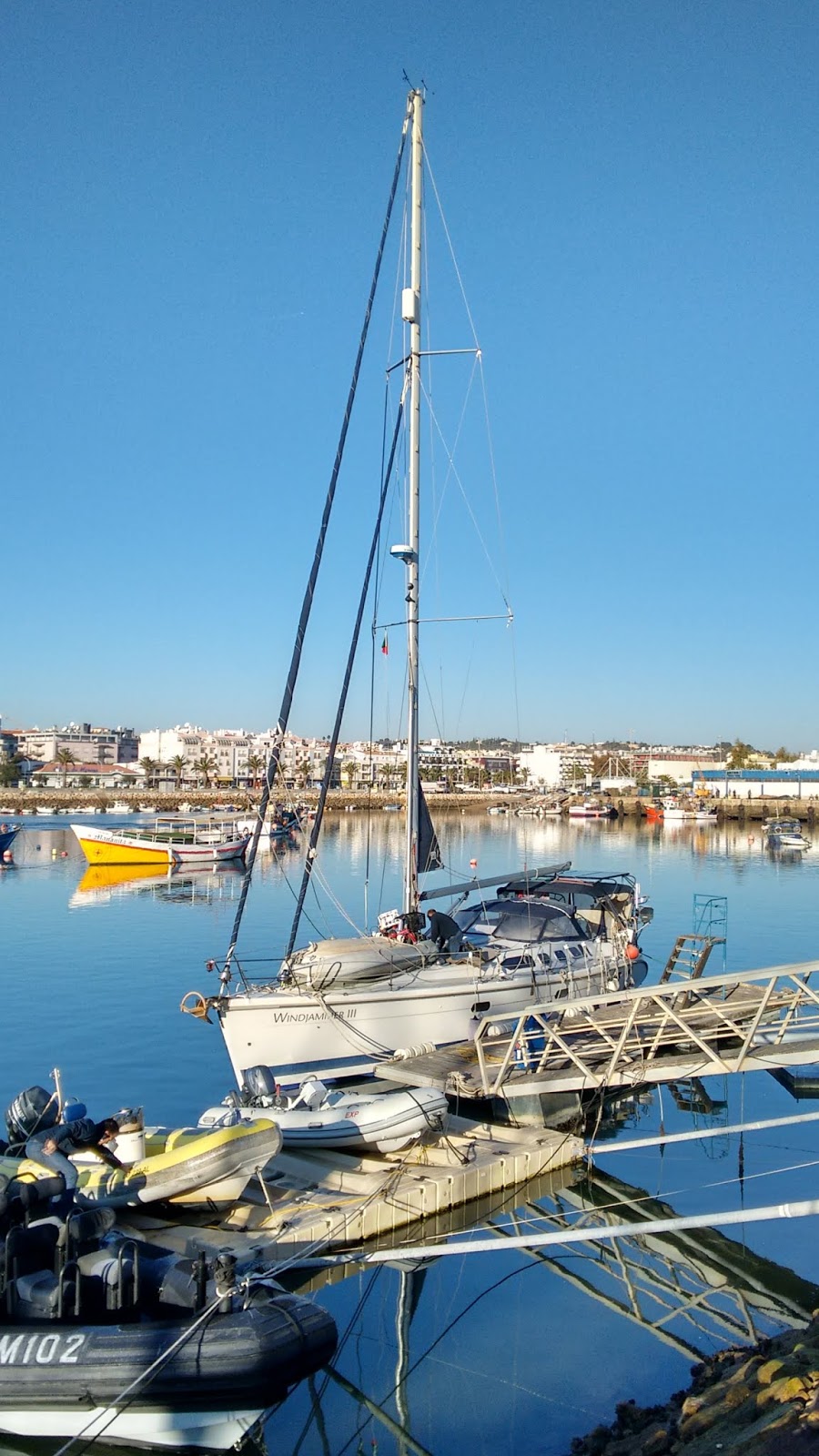
Summertime, December 2025 and up-river somewhere...

Taking a break...

Our Trusty Captain is currently working on updating his “WJ3 list of things that go wrong” in this, his boating life.  It shouldn’t take much longer, really…  It’s a simple matter of adapting to island life, just as the locals do.  No rush - takin' it easy!

Wednesday, November 13, 2024

Eating Humble Pie

St Lucia. Still. Leaving any day now... Sure!

Dear Friends,

Specifically, those who have commented on our blogs and never been answered, we send to you our most humble apologies.  Having managed our blogs for some 17 years now, the Galley Slave has only just stumbled upon the Comments section.  Here lie many missives, that until now, have mostly sat forlorn and unnoticed.  Oh dear! 

Our Galley Slave has just finished revitalising the now ageing blogs.  A perfect job indeed when on hurricane watch sitting in a marina for a few months.  Low season maintenance tasks!  We have six blogs to manage, with only two connected to our regularly accessed, email accounts.  These are the busiest blogs, although I hasten to add that none of them are appearing in any top ten popularity lists (just yet!).  That’s fine with us; we’re not in it for glory, money or bow bunny pix.  We started our blogs as an easy way of keeping contact with family and friends as we moved about and to have journals to remind us, in our dotage, of “our wilful youth.”  They are also a way for us to participate in and share with our communities.  The Cap’n writes of his boat maintenance efforts and GS, her travel and textile finds.  Our Cap’n is also a big fan of the Cruiser net community.  Many a problem has been thus solved.  

Thank you all for your efforts to engage us.  We shall endeavour to be more attentive and prompt in the future.  Always learning!  And a big thank you to everyone who reads and enjoys our adventures.

Celebrating the start of Year 17 with Miss WJ3
A good excuse and an even better champagne! 
Work/maintenance undertaken in 2024 and photos for 2023 and 2024 will be posted when we get home - in about 4 months!  GS's laptop is having it's own little holiday just now, making life a wee bit challenging.   

Tuesday, July 23, 2024

2023: Now for the Sails

Taking Stock of the Sails

Indeed, I love all my Doyle sails, as they are well built ie strong fabric, good shape, well sized for our boat, and have needed only minimal maintenance.  We have replaced the UV sunbrella stitching only once in all our years of ownership (now 16), and also a bit of repair to the yankee luff.  The yankee and the staysail furl and unfurl easily every time and they set very well IMHO.

In Mast Furling Mainsail

The in-mast furling mainsail not so much.  It's a fantastic sail...when it works. When it furls in and out fine, I love it.  When it won’t unfurl, it really pees me off.  There is never a problem furling it, unfurling is a different matter.  It becomes a huge chore, with help from at least a couple of others, to extract it from the mast...

Readers, and hopefully sympathisers, will recall that I had the mast re-tuned in 2023 to make it straighter.  The back story is that after replacing all the standing rigging in 2018, the mast was put back on the boat with a major bend in it – a no no for in-mast furling gear, so it needed correcting.  Quite frankly, after an enormous amount of research and the re-tuning of the mast in 2023, I believe it can only be a user error.  What I mean is this:  

At times, it works perfectly.  At others it does not.  So, I've concluded that it must occur as a consequence of user error.  I should add that I had the mainsail flattened a bit in 2018 so, all things considered, it should not have changed much over the last five years since 3 of those 5 the boat wasn’t being sailed.  So watch this space.  I might add that, as at Sep23, a basic new cross cut one will cost upwards of USD 3500.  We could all do without that!

Stay tuned.


Monday, July 22, 2024

2023: Time Well Spent in St Martin

 AIS Coupler

We have had a GMC AIST120 coupler for some years and it works but not so well as I would have expected.  The antenna is mounted on top of the solar panel frames on the back of the boat and, I would have thought, send out a decent signal to the horizon.  On our Atlantic crossing from Portugal to Antigua, via Madeira, Canary and Cape Verde Islands, we found that some ships, on a heading to cross near us, would suddenly change course when only a couple of miles from us.  I concluded therefore, that we had not been picked up by them until they were relatively close.  So I decided to do something about it.

I purchased a GMC AISS120 coupler and installed it next to the VHF radio.  The idea is to use the VHF antenna for the radio, for the AIS too, as the VHF antenna is on top of the mast.  Much better range for obvious reasons.  You can’t use the VHF radio and the AIS at the same time but we hardly if ever use the VHF at sea so it didn’t matter.

The major challenge for WJ3 was to connect the AIS and the AIS coupler – the AIS is at the chart table and the VHF radio is on the port side of the companionway.  After looking at all options for the cable run, I ended up passing the cable from the AIS along the starboard side to the mast, then back under the ceiling liner to the coupler.  I needed about 40’ of cable rather than the 20’ I had initially purchased before I looked in detail at the routing options.  Fortunately it didn’t cost much but lesson learned again.  Time spent in detailed reconnaissance is seldom wasted.

The cable came with fittings which were supplied by a helpful salesman at Electec in St Marten.  Our elec techie Mike, who was working on a bunch of other elec issues (see below), soldered the fittings on the ends of the cable for me.  Next time I would look at a YouTube video as it didn’t seem particularly difficult when Mike showed me how I could do it myself.

Mike also supplied a ‘black box’ to link my Ipad with Navionics (located at the helm mostly) to the AIS via wifi.  Worked well in St Marten with symbols for each AIS/ship/boat shown on the chart but now in Trinidad having difficulties with it.  I’ll update as I progress and, if necessary, I’ll defer back to Mike via email.

New House Batteries

We found that our house batteries were not holding a charge very well.  As they were now six years old, plus we were experiencing all these charging problems, so it was time indeed to replace them whilst in St Marten.  We looked at the options and came up with four new Trojan 6 volt DC 225 to give total 450AH for USD 1066.  

Sunday, July 21, 2024

2023: Electrical Issues Persist

One of LIfe's Big Mysteries

On the journey along the US ICW and through the Caribbean we found that, and particularly when motoring, the batteries did not charge very well.  We might be motoring for six or seven hours yet, at the end of the day, the batteries had not charged much.  When stationary and the sun is shining the batteries would show a fairly healthy state of charge, but if not sunny, we would have to run the gas generator.  So I sought the assistance of Mike in St Marten to, not only sort out the AIS/Navionics set up but to also trouble shoot the whole electric charging system.

Keep in mind that, when stationary, the fridge and freezer were operating 24 hr each day drawing, on average, about 5 amp hours.  When sailing/motoring there is an additional draw from the auto pilot, say 3-4 amps depending on conditions.  And at night time of course there is no charge coming into the batteries.

So, Mike started with the solar panels.  We found on a mid sunny day that the solar panels were producing around 16 volts each (should be 18-19 volts but still reasonable).  Three, spread over the arch, are hooked up in parallel.  On checking the wiring we found that there were two places along the cable where it had noticeably overheated.  Mike fixed this by cutting out about a metre of this cable and joining another (thicker) wire to the original cable to fill the gap.  Worked much better.

Next we checked the charge when the motor was running and the alternator was doing its thing.  The smart regulator showed that it was all okey on startup and shortly thereafter, so all seemed good.  We even tried the spare smart regulator to see if that improved things – according to Mike it did so I left it connected.

All seemed to be looking good and we departed St Marten and headed south/east.  Along the way ie a day or so later and while motoring between Nevis and Deshaies (pronounced day eh), Guadeloupe, I found the regulator had stopped working ie no lights showing at all.  I did not stop as the engine continued to run normally and we were pushed for time, plus the seas were quite lumpy and uncomfortable.  We stayed for a few days on a mooring in Deshaies, so I tried to fix the problem with the regulator, but without success.  I even tried to wire the internal regulator of the alternator (which is available for this alternator) but that did not seem to work either.

We pushed on to Pointe-à-Pitre, Guadeloupe where we were to be joined by my mate, Lawrie, from Oz, who just happened to be an electrician, computer nerd and self-made vehicle mechanic.  He wanted some work to do but he walked into a bit more than I think he anticipated and indeed was challenged.

After many hours of checking this and that, wires, terminals, multimeter checks, on engine, alternator, regulator, owner manual(s), fatigue, blah blah blah almost by accident, Lawrie found that the power cable for the regulator was loose at the fuse.  He found this by jiggling the wire while the motor was running and the regulator was not showing any lights.  Simple, and with a bit of fiddling of the fuse fitting so that it was much more secure, it has not failed since.

Next problem.  When running the engine our battery monitor would show 20 amps, say, belting into the batteries for about one minute and then followed 3-4 minutes of negative power flow ie no positive amps and just a few amps leaving the batteries.  This had us completely baffled and much checking (as above) followed.  Finally, Lawrie jiggled the excite wire and the AC tachometer wire, which were part of a plug assembly joining the regulator with the alternator, and low and behold the problem became obvious.  The plug assembly was intermittently connecting/disconnecting.  The fittings were made more secure and so power to the batteries became consistent ie starting with 20 amps and lowering as the batteries became more charged but always positive current flow into the batteries.  Much joy and celebrations followed, the engine charging problems, when the engine was running, appeared to be finally resolved.

That is, until we cruised into Carriacou, Grenada from Mayreau.  As we came to anchor, there was a nasty smell of burning electrical insulation/cable coming from below.  It sort of went away when we turned off the motor and could find nothing obvious, but the smell lingered. 

A couple of days later, when we motored into Clarke Courts Bay, on the southern side of Grenada, we checked more widely and thoroughly, and found the alternator wires, where the excite and tacho wire entered the alternator, had melted.  Lawrie then resurrected the old alternator, fitted it, and then everything worked (again).  (Clearly we've been keeping our visiting crew very, very busy this year!)

So, in September (2023) and on the hard in Power Baats Yard in  Trinidad, the ‘new’ alternator is in the repair shop and the old one is still fitted to the engine.  When the ‘new’ one comes back, assuming it is healthy, we will refit it and the old one will go back to being my trusty spare.

What caused the overheating/meltdown on the alternator remains a mystery!


Friday, July 19, 2024

2023: Outboards. Reliably Unreliable?

 Yamaha Outboard

Our faithful Yamaha worked fine and I was ever so proud of myself since I had made repairs the previous year and saved myself at least USD 3000.  That is until we got to Vero Beach in Florida when it would not cooperate and kept cutting out, or would power up only to die shortly after.  And then it wouldn’t start.  And we had only a few days before our guests arrived from Oz.  Talk about Murphy’s Law!

New Mercury 6hp 4 Stroke Outboard

So, rather than lose time working on, and may be repairing the Yamaha, we decided to get a new one, quickly.   A phone call or two and we had ordered a new 6hp 4 stroke Mercury available in the North Palm Beach store.  We could anchor a few kilometres near by and a kindly cruiser anchored near to me gave me a tow to the dinghy landing up a creek and the only place you could park a dinghy in that area.  I walked to West Marine and, against all their rules apparently, gave me and my new ob a lift back to the dinghy.  Off drove my friendly WM and I proceeded to fit my new Mercury to Bruce.  Only it wouldn’t start!  And, yes, I had fuel in the tank and it came with {a minimal amount of] sump oil.  Anyway, a friendly dinghy happened to be leaving the landing area and he and his family kindly gave me a tow back to WJ3.  Thank goodness for the boating community’s sense of helping each other in times of need...

The next day, after studying the Owners Manual umpteenth times and following the startup instructions, it still would not start.  So I called WM and they advised me that it was now out of their hands and I needed to discuss my problem with a dealer, which they were not.  WM just sell the stuff apparently.  And when I talked to a recommended ‘dealer’ they wanted me to deliver the ob with the appropriate paperwork.  And their work would have to be fitted in with all their other commitments, so nothing was going to happen quickly.

by now, our guests were sitting on a dock in West Palm Beach!  Oh well, nothing to lose, so I set the throttle on full power (not recommended) and pulled the starting chord.  BROOM.  All good.  I called WM and told them I had fixed it and how, and they were happy.  I was very happy and off we went.  Our guests, by this stage fuelled with a few happy-hour G&T's (American cocktail size), were very happy!

Four months later the Mercury started playing up (single cylinder remember) and a new spark plug fixed the problem.  Our Yamaha has had two changes of spark plugs in 15 years so I am now wondering if that might be the problem with that motor.  Anyway, the Yammy is now with a mechanic in Trinidad and, if they fix it as I expect they will, I will then have two ob.  Just like the alternator, it’s always handy to have a spare.

I later purchased, in St Martin, a throttle control variable tiller extension arm and it works a treat.  Even though the 6hp outboard can only comfortably move us through the water, when I am by myself and sitting forward, the RIB will comfortably plane.  I remove the extension when more than one person is on board.


Wednesday, July 17, 2024

2023: Back to a Cruising Life

Catching up at last: 2023

The Galley Slave and I rejoined the boat in Deltaville VA, Feb23 and cruised to Trinidad.  Along the way we experienced ongoing problems with the electrical charging system, amongst other things.  Quite the maintenance list, actually!

RIB Puncture

Bruce, our faithful RIB, had developed a leak in one compartment (port aft) and looked decidedly deflated when I rejoined the boat.  I tried to find the leak using a soap and water mix, several times with brush and spray, but could detect no bubbles.  It wasn’t until I launched WJ3 and Bruce that I was able to detect bubbles streaming up through the water from the leak.  It was an old repair gone bad and not small.

I pulled Bruce from the water onto the marina pontoon dock, turned it over, washed with fresh water, deflated the respective compartment, sanded and cleaned, and then glued a patch over the leak.  I carry spare fabric on board courtesy of a fellow sailor whose Hypalon inflatable had been written off.  

 I used West System G/flex thickened epoxy adhesive based on the advice of the local hardware and it has worked perfectly so far.  There was no Hypalon adhesive available locally in Deltaville.  You need to ensure that there is plenty of pressure and I used diving weights for this plus clamps.

Dripless Shaft Seal

On launching at Deltaville Boatyard the DSS wasn’t dripless, leaking a small amount.  The travel lift operator kindly assessed the problem and, with the help of a small sledge hammer, stopped the leak.  I think he just tapped the aft ‘bracket’ forward a bit to tighten the whole thing up and all is good.  I have never before had any problem and the DSS has been on the boat since I purchased it 17 years previously.

Whisker Pole

I wanted a whisker pole for the staysail when running dead downwind and I saw one on the side of the road among a pile of other boating junk.  I knew the owner (old Bob) and, after asking him if he wanted it to sell it to me, he gave it to me.  One end was a normal piston type end fitting and I wanted the same for the other end, which was some other useless fitting for my purposes.  I happened to have a spare spin pole end fitting and, after having it machined to fit my new pole, fitted perfectly.  I then found a 2nd hand slider fitting for the spinnaker pole track, purchased a locking slider and now all done, almost.  I now need to fit a block on the front of the mast and a topping lift.  All up it will have cost about $150.

I might also think about using this pole, which is pretty substantial, for a bowsprit for my asymmetrical top-down spinnaker furler.  We’ll see.

Fridges Not Refrigerating Properly

Shortly after leaving Deltaville and on our way southwards along the ICW our fridge and freezer were not getting really cold enough.  Yes, cold-ish but not like they normally should perform.  I checked most things but could not identify the problem: all lights were on that should have been on but the water pump wasn’t operating.  I checked for any blockages in the plumbing, electrical cabling and connections and even pulled the pump apart (as much as I could).  Finally, I checked the manuals and I noted the mention of a fuse in the control box.  I checked it and, sure enough, it had failed.  I replaced it and all good, both boxes cooled down as per normal in double quick time.  The lesson here is that, although all lights were on, not everything was working properly, clearly.  I just simply thought that if all lights were on then everything electrical must be working – wrong.  You never stop learning.

WAECO Fridge/Freezer

To add to this dilemma, our ever faithful WAECO fridge/freezer, purchased in 2010, decided to play up and finally died in 2023 after 15 faithful years of service.  Our built-in fridge and freezer can only be run when the boat is in the water as, to keep them cool, sea water has to flow around the compressors when they are running.  On land, which is a fair amount of time at the start and end of each season, we use the WAECO as a fridge and/or a freezer.  It’s mostly been a reliable companion, trusted importantly, with keeping our cold beers and food fresh.  The WAECO unit has been just great and we loved it.

However, rather than try to live with an old but unreliable friend, we ditched it and purchased another and, since we had friends about to join us in Florida, there wasn’t time to muck around.  Our new one is virtually the same as the old – a 50 litre Dometic portable fridge/freezer purchased from Fort Pierce West Marine as we made our way south along the Intra Coastal Waterway towards Florida.  She works just great and so we are very happy.  I should add that Fort Pierce Marina kindly let us hang off a dock while we jumped an Uber to West Marine to pick up our purchase.  Very friendly staff given that it was peak migration time for boaters heading north and not much room.  A nice marina experience.

 E-Bicycle

We purchased an Ancheer 20” folding electric bike to replace our folding bike stolen in Annapolis in 2019 (from a shop just opposite the local Police Station - as GS likes to remind me!).  It, like all e bikes, is comparatively heavy but, for my ageing body, is oh so easy to use.  It speeds along with very little effort and we have also fitted ‘saddles’ to make it a useful pack horse for trips to super markets etc.  One reason we went for this particular model (there seem to be 100s to choose from) was the aluminium ‘spokes’, disc brakes, and reviews it had received.  So far, we are very pleased with it.  

We also purchased stowage bags and have put four mounting brackets on the coachhouse roof so that we can tie it down with ratchet straps.  When sailing we also cover it loosely with the foredeck sunbrella awning and, after four months of sailing south through the Caribbean the bikes were in really good condition.  I also have upgraded the bike security locks and use them always.


Tuesday, July 16, 2024

2022: And in Conclusion

New Liferaft  

Our four man liferaft purchased in 2008 in St Marten was overdue for a checkup and, when trying to locate a liferaft servicing agent on the east coast of the US, found that it would be a costly exercise to ship it somewhere (Florida for example).  It would also cost at least one thousand USD to service (a quote over the phone) as the liferaft was well overdue for a service because of covid having delayed things.  

On balance we opted to purchase a new US-made one, three year inspections, offshore, cost effective solution.  We purchased a six man … liferaft and had it delivered to the boatyard at Deltaville and it was there waiting for us when we arrived back at the boat.  We went from a four man liferaft to a six man as the new rafts are considerably lighter than older ones, we will have guests on occasion and with four people possibly in the liferaft plus at least one jerry can of water this seemed a more appropriate size.  Cost difference of a six man vs four man was very small.

We also keep the liferaft in a valise in the main cockpit locker so it is weather protected, easily deployed and a valise is much lighter than a fiberglass-contained raft.  So, it's just a better option if only the GS is available to deploy it (I may be injured or worse).  Being in the cockpit will also make it easier to launch via our sugar-scoop stern.

Iridium Go from Predict Wind

This was purchased and carried in personal baggage from Oz to the US.  Fairly simple to set up the satphone and other hardware by following the instructions.  We have used it this season, almost exclusively for weather reports while at sea and out of range of the internet.  It works well and Predict Wind is a good charting program.  Unfortunately, most of their instructions are on the internet only, some are slightly out of date as equipment and programs have changed a bit over the years,  I also had to contact them several times for assistance (they respond helpfully within a day or so) but their whole setup could be improved with a comprehensive owners manual, which can be downloaded up front, much like other chart programs provide.  The other apps – Iridium Go and Iridium Mail – I hardly used and, even after registering for a new telephone number on line I still had to go and request what the actual number is.  

I would also suggest that Predict Wind offers some comparative information re Iridium Go vs Starlink, which appears to be a more popular internet setup here in the Caribbean among cruisers, as they also market this gear too.


Monday, July 15, 2024

2022: Love a bit of Sewing

Canvas Work

In 2022, I did quite a bit of canvas work as I have a small industrial sewing machine on board, a priceless investment that has paid for itself many times over.  

Dodger

The windows in the dodger, bimini and joiner between dodger and bimini needed replacement as they had aged and you could hardly see anything through them.  These would be the dodger’s third set of windows as the originals were made in 2008, replaced in 2011 in Gibraltar after breaking one on our Atlantic crossing, and now 10 years later, no surprise that they needed further replacement.

I removed the dodger and soon realized that replacing windows on such a large item, down below inside the saloon on the chart table, was to be a particularly difficult undertaking.  I viewed some videos, finding Sailrite’s splendid collection of extremely helpful ones, and decided to follow their method of making up various panels and then fixing them together using zips.  

My one piece dodger quickly became six panels – top panel, 2 x side window panels, and 3 x front window panels.  These are all joined using zips with velcro flaps to ensure water tightness.  See photos.  The whole thing was pretty involved (Sailrite make it look easy) but almost all good except for one or two things.  For example, for reasons that completely escape me, when I finally fitted the ‘completed’ dodger back together, some gaps between a couple of edges have developed in two of the front windows and I couldn’t completely do the zip up.  Now fixed.  The dodger is certainly more weather proof than it has ever been and much easier to pull apart and then make small repairs, which are required most seasons.

Finally, I made covers for the stainless steel tubing bows where they rubbed against the windows.  I had not done this previously and my old windows had developed long unsightly burn marks over the years.  I just cut up a towel and put Velcro along the edges then fitted them to the bows.

Life-sling Cover

The original woven cloth cover had succumbed to being out in the weather and so was starting to fall apart, leaving a mess below when we stowed it at the end of each season.  I pulled the old cover apart and measured, then sewed a new sunbrella cover but retained the plastic inserts.  A fairly simple project.

Winch Covers

I serviced the six winches and then made sunbrella covers for each of them.

Stowage Bags

I purchased line stowage bags from Oz and fitted them to hold the lines that run to the cockpit so that the lines are held above the cockpit cushions and there is no accumulation of dirt.  The bags have netting at the bottom so that any water runs out.  Two more are attached to the front of the steering pedestal and used for all sorts of stuff that accumulates in the cockpit eg sun screen, sun glasses, personal safety lines, cockpit light, water bottles, etc.  Buying them was easier than making them in this instance!


Sunday, July 14, 2024

2022: Outboards - Not for the Faint-hearted

Outboard 15 HP Yamaha.

In 2019 my outboard (ob) had developed a water leak from the area where the engine housing and the upper casing joined.  I was able to continue to use it all 2019 but only at slow speeds.  A local mechanic checked it out and told me what was wrong but he was busy and said I could do it myself, which would save me a lot of money.  

Okey then.  I tried to separate the two parts by removing six bolts but couldn’t do it – they appeared to be stuck together.  Forever!  I checked with a local ob business hoping for some friendly hints only to be told nothing helpful except that I should purchase a new ob as, they said, if they tried to repair,  it would involve a lot of work (echoing the previous assessment) and cost so much so just get another (new) one.  Only around USD 3000+ (AUD 4500) so why not.  Also the ob is 23 years old so, you know, you’ve had a good run.  

I slept on it that night (mostly awake) and decided to give it another shot the next day and, if I broke things, what the heck anyway.

What I tried was to insert a metal rod into the bolt holes of the upper casing and gently tap them with a sledge hammer working my way around all the holes one by one.  I did this over an hour or two without success until I inserted a small crow bar and levered the engine off the cowling.  Voila.

I had to replace the gasket and did so with a new one.  The challenge was to match my model number (British Virgin Islands) with US models and there are/were several models numbers for the same engine.  The local ob shop kindly did this and the new one fitted perfectly.  

The actual fault causing the water leakage was from a crack in a bend at the top of the copper tube joining the upper cowling with the water pump in the lower cowling.  This was not available at the time in the US so I purchased some copper tubing at the local hardware store and made my own.  It fitted very well and, when I put everything back together again, it worked well pumping water with no leaks.  I might add that I practised bending copper tube on some scrap metal I found in the boatyard before bending the final piece and fitting it to the ob.  Worthwhile, as you really only have one chance to make this right angle bend, so you need to get it right.

Outboard Propshaft Seals

I decided to change these, as I thought there was a small leak.  But first, some education - by looking at a bunch of very helpful YouTube videos, then choosing the simplest way I thought possible.  I removed the prop and spacer then drilled holes into the seals making every effort to avoid touching/scratching the prop shaft (as every video made a big deal of this!).  I then used small hook tools to extract each of the seals.  They came out quite easily.  I then replaced them with new ones using a PVC pipe, and used a hammer to insert them.  All seemed to work when I filled the gearbox and ran the motor in gear later on.  

Isn't it marvellous what a bit of self-help and lots of really nice people posting useful guidance on YouTube can do for you! And our 23 year old motor has a new lease on life too!


Saturday, July 13, 2024

2022: Time for Some WJ3 Work

2022 Mid Jul to Mid Oct 

In 2022, I travelled to WJ3 alone, to spend three months checking on the boat’s condition and to carry out as many repairs and maintenance chores I possibly could achieve in that time.  I'll begin with these odds and ends:

Cell Phone Dramas

There has always been a problem with organising local cell phone connections in the US for us Aussies.  For example, many companies require a social security number, which leaves out many plans.  In the past we had used sim cards from home (with an AU phone number) though not many local businesses liked to return our calls (ostensibly international rates although we were in the same local area most times!).  

Following Covid, a few of our travel sim providers folded, so we were back to square one this year!  You certainly do not want to be paying roaming rates for a few weeks, let alone 6 months.  We've tried various solutions over the years;  its just one of those services that continues to evade practical solutions.  Very frustrating when all you want is to talk to a knowledgeable tradie about your boat's issues - and we all know there's plenty of those... 

Non Skid on Deck Recess and In Between Forward Hatches

There is a recess on top of the coach house which used to hold a small solar panel.  The solar panel had long since gone and I never filled the recess.  So, it was often full of water when it rained.  To remedy this, I cut out a plywood panel from scrap I found in the boatyard, which was thick enough to fill the hole.  I fibre-glassed it with cloth,  sealed it in place with self tapping screws and sealant, then painted it with non-slip paint.  An easy fix.  Should have done it years ago!

While I was at it, I also masked off a small area between the two forward hatches where there was just bare fibreglass.  It was dangerously slippery when wet.  I painted it with non-slip paint, making a big difference to crew safety.  To match colours, I had taken a photo of the hull to the local hardware store (the ever-friendly Hurds Hardware in Deltaville) where we colour matched my paint.  It looks fine and now works a treat. 

Top Down Spinnaker Furler

In the interests of setting WJ3 up to be sailed single-handed, I purchased a Sveggen top down spinnaker furling kit from Rolly Tasker Sails.  Needless to say, it has yet to be fitted, except for the stanchion fairleads.  We had hoped to play with it but since this year our heading has been into and/or to windward there has simply been no need.  Next year, when we expect to head north, I’m looking forward to using it.  I might also try to utilise my new staysail whisker pole as a removable bowsprit since it is a fairly heavy section and a short pole.


Friday, July 12, 2024

2020-2021: The Drawbridge was UP!

2020 and 2021: Two years lost

Don't you just sometimes have to go with what life delivers?  We remained away from WJ3 thanks to Covid.  Worldwide travel restrictions did not allow any opportunity to visit the boat, so I had to make do with fixing stuff on the house.  Timber houses always have lots to do anyway...  We weren't idle but very much missed the cruising life.

Added a "Granny Bar" to the daily ride

Babysat the furry grandchild

The river flooded again

Celebrated a birthday with a picnic on the river

Helped GS tidy up her sewing area

Did a bit of canvas work in my sewing area

Helped rescue someone stuck on the mud bank

Cleaned the dingly's bottom
(note improved bimini with clear windows now!)

Looking forward to relaxing on the balcony with a beer after a 2 year holiday at home


Thursday, July 11, 2024

2019: One Lifeless Generator

2019 in Review

On Board Diesel Generator

In 2018, all efforts to get our Northern Lights generator to run were unsuccessful.  Whenever I had mechanics look at it, both in Antigua and then again in St Marten, they would turn it over but could not get it to start.  (The guy in Antigua offered to take it off our hands, so we had a suspicion that it was not completely worthless!!)  No one knew why and so it remained useless until we arrived in Deltaville in 2019.  I then made enquiries about having yet another mechanic check things out while in on the hard at Deltaville Boatyard.  I was asked if the motor was turning over and I had to answer that it appeared to have seized as, when I checked it that morning (some two months after St Marten), it would no longer turnover.  I then decided to not do anything (out of time that year) other than put automatic gearbox oil into the cylinders after removing the injectors and (as at 2023 in Trinidad) I am only now getting the generator seen to.  I’ll let readers know the outcome just as soon as I know.

Electrical Improvements

While on anchor opposite the Deltaville Marina for an extended period (before our friends arrived) I had a good opportunity to work on the boat’s electrical system.

Apart from purchasing and fitting the new alternator I tidied up all the wiring under the chart table seat.  Over the years, as various work was undertaken by numerous techos, the boat had accumulated a spaghetti like collection of cables which had become a bit of an eyesore and very imposing whenever an electrician saw it for the first time.  I basically tidied it up by cutting and shortening a bunch of the battery cables while at the same time fitting a couple of ACRs (automatic charge relays).  These things take power from the house bank when it reaches about 13 volts and send some charging to the start battery and also the bow thruster battery.  

You might recall that when the Sopromar Boatyard installed the bow thruster they also installed bow thruster batteries but they could only be charged when the engine was running! They could not be charged by the solar panels as the solar panel regulator could only charge two banks – house and starter.  The ACRs solved this problem and so when on shore power, engine alternator and/or solar all battery banks were being charged (providing everything else worked of course – read on).

To give me the capability to cut and fit new terminals on battery cables I purchased an hydraulic swager kit (for not much), a valuable purchase via Amazon/EBay.

Gasoline Generator

We purchased a gasoline/petrol generator, Powerhouse 2000, which we used  when bad weather settled over several days and the solar panels weren't generating sufficient power for our needs.  Didn’t use it much but useful to have as a backup.

Electrical Performance After Improvements

After these electrical modifications, everything seemed to work fine, particularly when testing over short periods of time.  However, while out cruising with friends and running the engine for several hours, I never seemed to get to the full charge that I expected.  Good weather, solar charging and staying at marinas more frequently, kept the batteries up to speed.  See 2023.


Wednesday, July 10, 2024

2019: Movement at the Station

So, let's start with 2019

The posts to follow cover an extensive period, 2019 to 2023.  Essentially, after a fun time at Deltaville in 2019, there has been little boating activity to report.  Of course, in 2020 – 2021 (due to Covid) we had to stay home in Oz.  And be very good indeed.  

Then 2023 became the year of "will we-won't we" as we chopped and changed between taking WJ3 home to Aus or staying on the East Coast, US.  We decided to stay, though changing course by adding a cruise to Trinidad for old times sake, down through the Caribbean, instead!   

Overheating Engine.

When leaving Norfolk (to meet friends - perfect timing yet again!) the engine overheated.  We crept back to the anchorage and, as quoted from our sailing blog:  “the Cap’n put to work on finding the culprit.   After our Cap’n Resolute crawled all over the engine, cleaned sea creatures from water filters and took a dip in less-than-appealing river waters (to check drains), off we set, yet again.  Only to watch the temperature gauge rise steadily again.  Oh dear, back to the anchorage and time to consult those (many) manuals.  By the time we found the culprits – two not-so-tight hose clips allowing seawater to leak into the bilge when the engine revs were raised as we powered forward.”  Sometimes it's just the simple things!

2109 General

In 2019 we did little sailing and generally remained in Jackson Creek, Deltaville until friends from Oz joined us and we went travelling around the Chesapeake and land exploring.  It was a great opportunity to tackle some burning issues, principally electrical, that had dogged our return voyage from Europe the previous (two) years.

Ongoing Engine Electrical Charging Challenges 

I was still not happy with the charging regime and my work on the smart regulator the previous year still did not provide for reliable charging when running the engine.  As the smart regulator was now working correctly (I thought) I turned against the alternator and replaced it with a new one, a Balmar Series 6, 100 amp hour (virtually same as the old one).  I was going to have the old one tested but circumstances did not allow so I just went ahead and, if the old one was actually serviceable, then I would have a spare which is no bad thing.  (See 2023).

See my entries for 2023 for a pretty detailed analysis of my ongoing electrical dramas but with some pretty good outcomes. 

Photos to follow....eventually

Monday, February 18, 2019

2017 & 2018: Bless Those Batteries

Ongoing Saga: #11

Solar Panel Regulator, New House Batteries and New Smart Regulator for Alternator.

This was the beginning of a long drawn out and rather expensive saga over a period of nine months.  Sopromar Boatyard in Portugal were asked if they could come up with some charging solution for my three sets of batteries while I was away back home – a single 12 volt starting battery, four 6 volt house batteries and 2 bow thruster batteries.  In the numerous exchange of emails over several months the result was that there wasn’t a solution.  Meanwhile the regulator for the solar panels had malfunctioned, needed replacing and that subsequently the four house batteries had gone flat and needed to be replaced, which they duly did ie solar regulator and batteries.  The old batteries were almost 10 years old – a ‘Trojan’ performance, so probably time for new ones.

At the same time I also had the alternator checked out and we identified that we needed a new regulator for it, which I purchased separately and brought back over with me when I returned to the boat in mid Aug17.  Sopromar fitted the new regulator, tested it and that was that.  Or so we thought.

The bow thruster batteries are AGM and so had held up fairly well and the techo had wired them up somehow so that they received a trickle charge of some sort from the solar panels and didn’t flatten.  AGM batteries can fairly happily sit for up to around six months without any charging and not suffer I’m reliably informed.  

Anyway, to cut a long story short the new regulator was not wired correctly and so the batteries steadily drained once we got underway, except for some charge from the solar panels (which only charge the house batteries and starter battery).  The bow thruster battery charging only occurs when running the motor/alternator.  To add to this mix, we had a generator that didn’t work.

Our batteries were recharged on shore power whilst ever we were in marinas at Lagos, Madeira, Canary Islands and then Cape Verde Islands.  In between were relatively short trips so I wasn’t too concerned as the solar panels did their thing outstandingly and I rarely used the bow thruster.  It was on the 16 day Atlantic crossing that I became fully aware of the charging problem as the starter battery voltage in particular dropped significantly, although I was always able to start the engine when I had to.  

On arrival in Antigua (where we anchored) I had an electrician look at the charging system and he thought it was all okey, particularly when his meter showed 12.6 volts (not the 13 – 14 volts necessary) and he thought the regulator was doing what it should.  He also condemned the house batteries as needing replacement even though they were less than 12 months old.  

No point arguing, so we pushed onto Sint Maarten, initially on anchor but later on shore power at FKG Rigging, where I was able to charge the batteries using shore power.  I also had the house batteries charged and tested at Budget Marine where they were announced as being in good condition.


Next stop was Turks Caicos (shore power in the marina) where another electrician, a friendly French Canadian, made a valiant effort to identify the problem of a very low charge and suggested that the regulator was faulty, only achieving ‘float’ voltage instead of starting with ‘bulk’ and moving through ‘absorption’ and then onto ‘float’.  He also had access to the regulator manual and spoke to the manufacturers but thought it was wired correctly.

We entered the US at West Palm Beach, Florida and then proceeded north along the Intracoastal Waterway anchoring most nights - happily for as long as we had sunny weather.  Unfortunately, further problems were experienced when we had a succession of overcast days and the batteries received very little solar power.   We then experienced some difficulty when anchoring off New Smyrna Beach using the electric anchor winch.  The starter battery was quite sick by now so, with Daytona in our sights, we kept the engine running all night, pulled the anchor up by hand the next morning (thankfully it was clean sand), and made for Daytona Beach.

We berthed in Halifax Harbour Marina (great people and very friendly fellow boaties).  I tried to charge the starter battery using shore power but it would not hold a decent  charge so I had to purchase a new one.  I also consulted with a trusted electrician who had done some work on the boat about 9 years previously after the mast had been hit by lightning.  He is semi-retired now and advised that I should do it myself – every good captain should know how to set up a regulator he said - so read the manual at least three times – and then do what you need to.   I followed his sound advice and found that the regulator was wrongly wired, wired it correctly myself, and now all batteries are charging pretty efficiently, although I sometimes wonder if the starter battery should not be getting a bit more charge.

In summary, three electricians couldn’t get it right, but the fourth electrician gave me best support of all – do it yourself.  Lesson learned, big time.


Sunday, February 17, 2019

2017 & 2018: Oh NO! Not the Generator...

Ongoing Saga: #10

Generator Not Starting and Fuel Line Fitting in Canary Islands
.  
In Portugal the diesel generator had been sitting for 9 months and wouldn’t start for reasons I could not understand, so I had a mechanic look at it – several as it turned out.  They replaced the gasket for the cover over the valves, checked valve clearances, adjusted them and eventually they started it and we ran it several times.  Great.  They did not think the injectors needed attention as ‘it runs so well’.  Anyway, off we went and it NEVER started again.  

When in the Canary Islands I discovered, while trying to start the generator, that a bleed valve over the fuel line was not seating properly as the thread would not allow full tightening.  Ah ha!  I thought, this must be the problem – allowing air into the fuel lines – a definite no no.  Fortunately, a visit to one of the marina chandleries proved fruitful and the very helpful gentleman there found a suitable fitting somewhere out the back of the shop which matched my fitting.   It cost next to nothing too and I was so grateful.  Even so, the generator would still not start.

I had two other mechanics check the generator over for me – in Antigua and then Sint Maarten – and they could not start it.  We didn't have time to wait in the Turks Caicos (the weather was a bit iffy) or I would have had a mechanic go over it there too.  The motor turns over fine but just won’t start.  

The consequences of course made themselves clear as we moved along the Atlantic ICW (US coast) where we anchored out rather than hooking up to electrics at marinas.  See comments on batteries.  The plan is to have our very sad generator checked out again when I'm back in the USA.  Another job for next year...


Friday, February 15, 2019

2017 & 2018: Benefits of a Shakedown Cruise

Ongoing Saga: #9

Mast Step Repair.  A piece of the aluminium casting at the back of the mast step came away when I was adjusting the mainsail not long after we had launched and, fortunately, were just doing a quick "shakedown" cruise along the Portuguese coast to Faro and back. 
Not pretty but so thankful we were not out in the deep blue briney

This piece had always held a number of ss shackles holding blocks that led lines back to the cockpit.  The boat had always been set up this way and, I guess, over the years the ss shackles had worn into the aluminium casting until it eventually failed.  At the same time it exposed two (of the 4) bolts that held the mast base in place.   Interestingly, below the aluminium mast base is a ss plate that has vertical edging with holes that accommodate shackles attached to blocks.  On the rear side of the ss plate there are also holes that had simply not been used as the shackles had been attached to the aluminium mast base instead.
Inspecting the damage
Sopromar Boatyard repaired the mast base by fabricating a stainless steel bracket that covered the broken area, utilizing the two exposed bolts, and then to reinforce things the fabricated bracket was welded to the ss mast base plate.  Any gap between the new ‘cap’ and the original mast base was filled with silicone sealant.  

You'll be pleased to know:  It held perfectly during our 2017/2018 Atlantic crossing and was left in place on the recommendation of the chief rigger when we subsequently had the standing rigging replaced in Saint Martin by FKG Rigging.


Repair all done & we're off to Madeira

Thursday, February 14, 2019

2017 & 2018: Reviewing Safety & Security

Ongoing Saga: #8

Main Hatch Storm Lock.  I decided that our main hatch should have some better means of securing the hatch in the closed position and also for the storm boards to be securely held in place.  On the top storm board (there are 3, one on top of another) I mounted simple ss slides so that, when the bolts are slid into their respective holes drilled into the side of the hatchway, they locked the top storm board in place.

For the sliding hatch, which is just a flat piece of acrylic, I drilled two holes, one on either side of the hatch, so that I could slide a pin down into a length of plastic beading that I had screwed to the sides of the hatchway.  I can lock the hatch closed in this position by sliding the pin in place from either top or bottom, and if necessary, the person inside the boat can also slide the pin out without anyone’s assistance from the cockpit.  I can also lock the pin from below to provide security and prevent anyone entering the inside of the boat eg when on a town dock in a place with doubtful security.

Flares.  I needed to add to my considerable stock of rescue flares as they were all out of date.  You cannot purchase flares in Portugal without going through a very convoluted and involved bureaucratic process as the authorities have designated flares as explosives.  So, I guess if people there are interested they travel to another EU country, purchase flares there then bring them back to Portugal without declaring them.  A very stupid policy.  I might add you cannot purchase them via the web as it is illegal to mail them around the EU.

So, on our arrival in the Canaries (Spain), we were able to purchase a new set over the counter at the local chandlery.  Apart from the obvious of having up-to-date flares on board, yesterday as I write this (15Apr18 at Brunswick Landing, Georgia, USA), we were boarded and inspected by the US Coast Guard as we approached our marina.  They were happy that I had current flares and, interestingly, didn’t care about all the other out of date ones that were stored with them in our getaway bag.

Jordan Series Drogue.  Years ago I had purchased a kit from Sailrite and laboriously attached 138 cones to the line they supplied.  With the Atlantic crossing looming I decided to finish it off properly and have it instantly available in the cockpit to deploy whenever I needed to.  There’s more to having a series drogue than just a line with the recommended number of drogues.  A lot has been written about them since I purchased mine 10 years ago and some pretty good lessons have come out as a result of sailors using them under extreme conditions.  Interestingly, many sailors did not agree on all aspects so I had to make some decisions myself. I also consulted my son, who is a rope access technician, and spend his work days with his life dependant on the lines he sets for himself.  He had some good advice about rope stress points and where best to secure the drogue on the boat.

The attachment point for the bridle at the stern is very important ie it’s recommended that it needs to be something a bit better than the stern cleats or cockpit winches, although some boats have utilized these in extremes when they had to deploy their series drogue.  I decided that the base of the legs of my standard stainless steel arch would be adequate.  There are two base plates each side bolted (4/plate) to the deck with metal backing plates. 

There is also much discussion whether one should rely on knots or utilize splices.  Splices won hands down when it came to tests.  I did need to rely on a knot where the bridal lines were attached to the arch and I chose to use a knot called the double fisherman's loop, which held up about the best in one particular testing by Yachting Monthly (YouTube video) that I reviewed ie it’s about as strong as an eye splice.  


So I purchased new 18mm braided nylon line, spliced it then attached the bridle to the eye that I also spliced into the leader.  The ends of the bridle I attached to the base of the arch.  At the far end I linked a bunch of chain of various lengths that I had on board and moussed the  shackles used to join them all.  Finally I put it all into a bag (old sail bag) and secured it with line to various points on the pushpit and arch nearby. 

In the event I had to use it I planned to flake the drogue on the cockpit floor before launching it or, if in a hurry, I could just deploy it straight from the bag but you can never be sure that it won’t become tangled and it’s too late if it’s on its way out being pulled by all the drogues filling.  Anyway, I have never had to use it thank goodness but it certainly provides peace of mind knowing that it is all done and ready to go at very short notice.

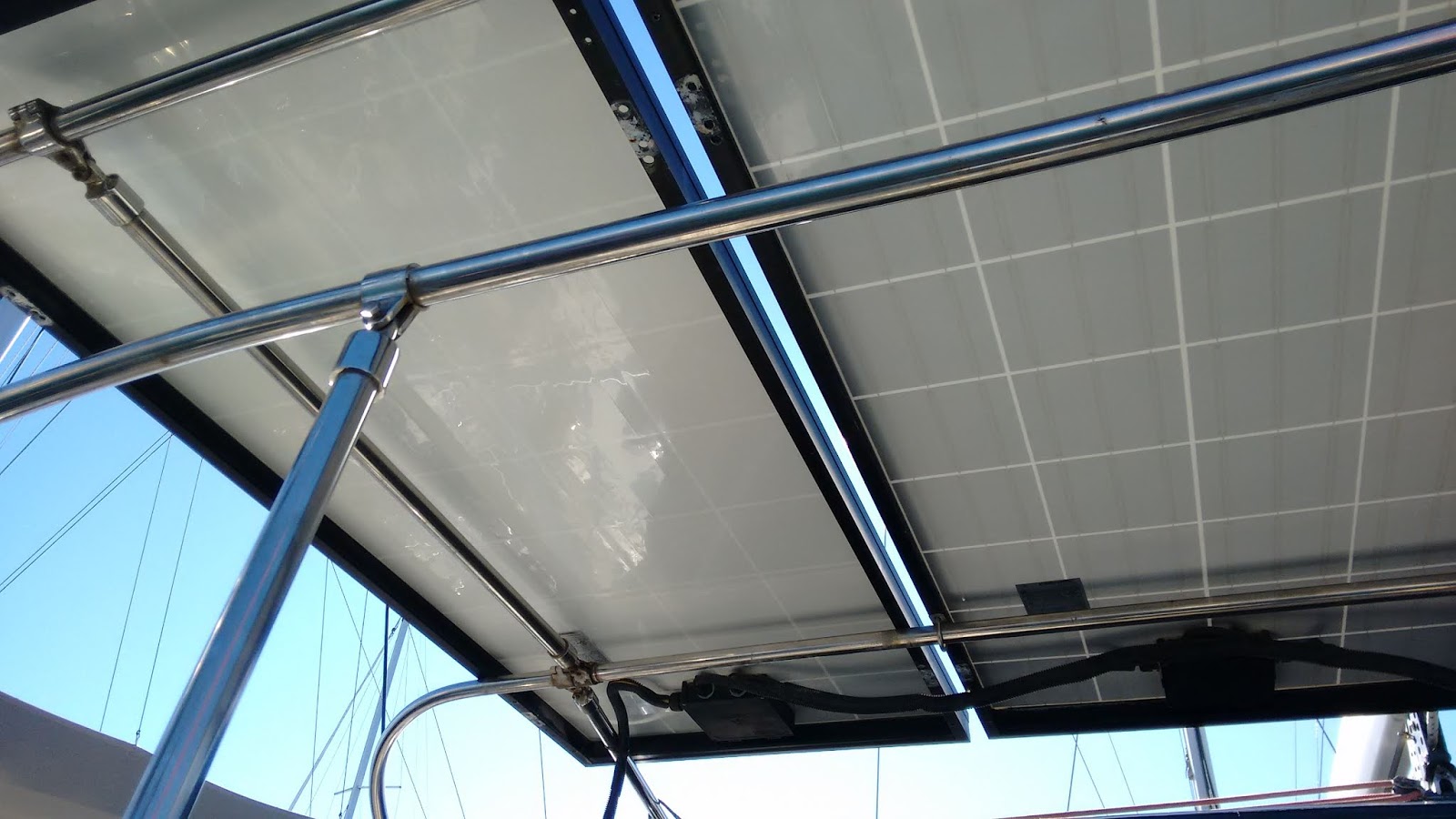
Hydrovane.  Yes, it was time to put the Hydrovane back in business ready for our Atlantic Crossing.  I find it adds an extra rudder giving me some backup if ever we need it too.  It all fitted on well, except I noticed that the vane was connecting with our solar panel framing.  Not good for the vane fabric.  So whilst waiting for the mast repair to be undertaken, I used the time in Portimao Marina to move the solar panels forward a bit.  Easier said than done.  Time well spent.

The Hydrovane (red vane) rubbing on the solar panels.  Lots of kissing in the night!


Moved further apart - all good now

Wednesday, February 13, 2019

2017 & 2108: Electronic Wizards. Perhaps Not...

Ongoing Saga: # 7

EPIRB Purchase.  I already have two EPIRBS – one PLB and a GME EPIRB, which had a battery that tested okey, but it was past the recommended change date.  So, I thought I should purchase a new one and decided to get an Australian one which would be automatically accepted by the Australian Maritime Authority (AMSA).  The GME was purchased in Oz and brought overseas with me years ago.  I only found that its battery was out of date when I arrived at the boat in Portugal.  

Anyway, I thought that importing a bit of safety gear into Portugal wouldn't be too much of a challenge.  I also understood that courier/shipment companies generally handled customs etc.  As things turned out my purchase was posted via the Oz Post Office which created all sorts of issues.  Firstly, although quickly despatched, it took almost two months to arrive at the boatyard, required a substantial customs payment, and the company that I ordered it from really didn’t show much interest.  I could not trace the item’s whereabouts on route.  The Oz Post Office I assume just send it on its way with no further interest, unlike UPS, DHL, FEDEX that I'd dealt with before.  The company even suggested that I follow up through the Portuguese Customs, which I eventually did once they contacted the boatyard to advise that the package had arrived in town nearby.  Any action beforehand would have been quite fruitless on my part due to being a foreigner, English speaking only, etc.

Once it finally arrived it should have been easy to register it with AMSA via the net but my registration was rejected because an EPIRB with my serial number had already been registered, believe it or not.  It took several phone calls to try to get AMSA to follow up.  Once again the company who sold me the EPIRB showed little interest and just referred me to the EPIRB manufacturer - kti.  By sending emails to both AMSA and kti the situation was eventually sorted.  My serial number WAS the correct one as it turned out and the other registered owner was contacted and provided the right serial number of their EPIRB.

In future if I am overseas and need to purchase another EPIRB, I'm likely to just purchase it where I can pick it up myself; although that has inherent registration issues.  Well, perhaps if my 10 year guarantee remains valid I might not need to.  (I doubt it as I anticipate that some new rule will be introduced soon requiring all current EPIRBS to be replaced in the next 2 years, although perhaps I am being a bit cynical in my old age).   Meanwhile, I have now have 3 EPIRBS, which all test okey.

VHF Handheld Radio.  The old one wouldn’t hold a charge so we purchased another while in the Canaries.

Sky Mate Antenna.  SkyMate is a satphone type comms gear which we installed 10 years ago.   It still operates so we decided that we would just renew our subscription as they advised that our old equipment is still okey but would be better if we upgraded with new equipment costing around 1000 USD or so.  We decided not to and subscribed so that we could use it and get used to using it again.  

Firstly, we had a number of problems with reception, and sending messages.  We contacted tech support, who it must be said worked very hard to solve our issues.  Things dramatically improved when I cleaned the antenna terminals and then moved the antenna away from other antennas and mounted it up on the framing that holds our solar panels above and behind the cockpit arch.  This was a major improvement and we thought it had solved all our problems.

Not quite!  As we were now using the equipment to get used to it but Microsoft (Windows 10) had other ideas.  It would not let us properly send and receive.  Microsoft would say indicate a problem and closed the Skymate.  We devised various ways to bypass and act quicker than Microsoft could hinder us so we got by with being able to send emails, mainly to report our position via message.  Eventually we exceeded our monthly allocation and our emails were rejected but this was fixed, again by tech support, who simply allowed the mails to be forwarded and billed us accordingly.    The fact that there was no notice to warn us we were approaching our limit is a major shortcoming of this equipment.  We were mid-Atlantic at the time and sending regular position reports to our blog.  We will certainly be considering alternate systems for future "blue water" use.

iPad.  My eldest son had given me an iPad and I love it.  Aside from the Kimble application (I do read a lot when sailing) it also takes Navionics charts, so I can have it in the cockpit with me.  The charts are especially useful when entering/leaving harbour.  With further use on the open ocean I found that I would not even bother to go down below to view the CMap chart on our laptop on the chart table.  The iPad Navionics is connected to a small Garmin Bluetooth GPS so that sits below sending signals to the iPad and I just turn it on every now and again to check progress.  So simple and easy to use.

I have even put together a small stand for it: a bamboo cutting board from a Chinese shop, and a clamp fitting that I screwed it to so that I could attach it to a handrail on the steering pedestal.  The iPad is held in place with a couple of small bungee cords.  It has been especially helpful while motoring along the US Intracoastal Waterway and far exceeds the CMap charts usability.  With Navionics you can zoom in and out to infinite settings – whatever is comfortable but zooming in is very important when navigating around channel markers in shallow shoaling waters.  CMap is extremely limited in this capacity; at least using it with the chart program Software on Board.

A couple of drawbacks, however.  While crossing the Atlantic - Cape Verde Islands to Antigua - a message came up from Apple that I needed to re-register and that I could do it from any place that I could access the web.  It locked up the iPad until I did and this all happened mid Atlantic.  Luckily we still had CMap which worked fine.  I wasn’t able to use Navionics again until I reached Antigua.  This is a very REAL safety issue.

Secondly, my iPad is in a waterproof plastic wallet so it is protected in the rain.  If the screen does get wet it will not function as a touch screen, just won’t do anything or will do very strange things so that it becomes unusable.  On one occasion on the ICW the rain was so fierce that I could not use the iPad (and I could hardly see to look for oncoming traffic) so I pulled over just out of the channel and dropped the anchor.  I’m sure there is a techie answer and I’ll put it in here when I find it.


We seem to be going in circles...