Showing posts with label safety. Show all posts

Tuesday, July 16, 2024

2022: And in Conclusion

New Liferaft  

Our four man liferaft purchased in 2008 in St Marten was overdue for a checkup and, when trying to locate a liferaft servicing agent on the east coast of the US, found that it would be a costly exercise to ship it somewhere (Florida for example).  It would also cost at least one thousand USD to service (a quote over the phone) as the liferaft was well overdue for a service because of covid having delayed things.  

On balance we opted to purchase a new US-made one, three year inspections, offshore, cost effective solution.  We purchased a six man … liferaft and had it delivered to the boatyard at Deltaville and it was there waiting for us when we arrived back at the boat.  We went from a four man liferaft to a six man as the new rafts are considerably lighter than older ones, we will have guests on occasion and with four people possibly in the liferaft plus at least one jerry can of water this seemed a more appropriate size.  Cost difference of a six man vs four man was very small.

We also keep the liferaft in a valise in the main cockpit locker so it is weather protected, easily deployed and a valise is much lighter than a fiberglass-contained raft.  So, it's just a better option if only the GS is available to deploy it (I may be injured or worse).  Being in the cockpit will also make it easier to launch via our sugar-scoop stern.

Iridium Go from Predict Wind

This was purchased and carried in personal baggage from Oz to the US.  Fairly simple to set up the satphone and other hardware by following the instructions.  We have used it this season, almost exclusively for weather reports while at sea and out of range of the internet.  It works well and Predict Wind is a good charting program.  Unfortunately, most of their instructions are on the internet only, some are slightly out of date as equipment and programs have changed a bit over the years,  I also had to contact them several times for assistance (they respond helpfully within a day or so) but their whole setup could be improved with a comprehensive owners manual, which can be downloaded up front, much like other chart programs provide.  The other apps – Iridium Go and Iridium Mail – I hardly used and, even after registering for a new telephone number on line I still had to go and request what the actual number is.  

I would also suggest that Predict Wind offers some comparative information re Iridium Go vs Starlink, which appears to be a more popular internet setup here in the Caribbean among cruisers, as they also market this gear too.


Saturday, July 13, 2024

2022: Time for Some WJ3 Work

2022 Mid Jul to Mid Oct 

In 2022, I travelled to WJ3 alone, to spend three months checking on the boat’s condition and to carry out as many repairs and maintenance chores I possibly could achieve in that time.  I'll begin with these odds and ends:

Cell Phone Dramas

There has always been a problem with organising local cell phone connections in the US for us Aussies.  For example, many companies require a social security number, which leaves out many plans.  In the past we had used sim cards from home (with an AU phone number) though not many local businesses liked to return our calls (ostensibly international rates although we were in the same local area most times!).  

Following Covid, a few of our travel sim providers folded, so we were back to square one this year!  You certainly do not want to be paying roaming rates for a few weeks, let alone 6 months.  We've tried various solutions over the years;  its just one of those services that continues to evade practical solutions.  Very frustrating when all you want is to talk to a knowledgeable tradie about your boat's issues - and we all know there's plenty of those... 

Non Skid on Deck Recess and In Between Forward Hatches

There is a recess on top of the coach house which used to hold a small solar panel.  The solar panel had long since gone and I never filled the recess.  So, it was often full of water when it rained.  To remedy this, I cut out a plywood panel from scrap I found in the boatyard, which was thick enough to fill the hole.  I fibre-glassed it with cloth,  sealed it in place with self tapping screws and sealant, then painted it with non-slip paint.  An easy fix.  Should have done it years ago!

While I was at it, I also masked off a small area between the two forward hatches where there was just bare fibreglass.  It was dangerously slippery when wet.  I painted it with non-slip paint, making a big difference to crew safety.  To match colours, I had taken a photo of the hull to the local hardware store (the ever-friendly Hurds Hardware in Deltaville) where we colour matched my paint.  It looks fine and now works a treat. 

Top Down Spinnaker Furler

In the interests of setting WJ3 up to be sailed single-handed, I purchased a Sveggen top down spinnaker furling kit from Rolly Tasker Sails.  Needless to say, it has yet to be fitted, except for the stanchion fairleads.  We had hoped to play with it but since this year our heading has been into and/or to windward there has simply been no need.  Next year, when we expect to head north, I’m looking forward to using it.  I might also try to utilise my new staysail whisker pole as a removable bowsprit since it is a fairly heavy section and a short pole.


Friday, February 15, 2019

2017 & 2018: Benefits of a Shakedown Cruise

Ongoing Saga: #9

Mast Step Repair.  A piece of the aluminium casting at the back of the mast step came away when I was adjusting the mainsail not long after we had launched and, fortunately, were just doing a quick "shakedown" cruise along the Portuguese coast to Faro and back. 
Not pretty but so thankful we were not out in the deep blue briney

This piece had always held a number of ss shackles holding blocks that led lines back to the cockpit.  The boat had always been set up this way and, I guess, over the years the ss shackles had worn into the aluminium casting until it eventually failed.  At the same time it exposed two (of the 4) bolts that held the mast base in place.   Interestingly, below the aluminium mast base is a ss plate that has vertical edging with holes that accommodate shackles attached to blocks.  On the rear side of the ss plate there are also holes that had simply not been used as the shackles had been attached to the aluminium mast base instead.
Inspecting the damage
Sopromar Boatyard repaired the mast base by fabricating a stainless steel bracket that covered the broken area, utilizing the two exposed bolts, and then to reinforce things the fabricated bracket was welded to the ss mast base plate.  Any gap between the new ‘cap’ and the original mast base was filled with silicone sealant.  

You'll be pleased to know:  It held perfectly during our 2017/2018 Atlantic crossing and was left in place on the recommendation of the chief rigger when we subsequently had the standing rigging replaced in Saint Martin by FKG Rigging.


Repair all done & we're off to Madeira

Thursday, February 14, 2019

2017 & 2018: Reviewing Safety & Security

Ongoing Saga: #8

Main Hatch Storm Lock.  I decided that our main hatch should have some better means of securing the hatch in the closed position and also for the storm boards to be securely held in place.  On the top storm board (there are 3, one on top of another) I mounted simple ss slides so that, when the bolts are slid into their respective holes drilled into the side of the hatchway, they locked the top storm board in place.

For the sliding hatch, which is just a flat piece of acrylic, I drilled two holes, one on either side of the hatch, so that I could slide a pin down into a length of plastic beading that I had screwed to the sides of the hatchway.  I can lock the hatch closed in this position by sliding the pin in place from either top or bottom, and if necessary, the person inside the boat can also slide the pin out without anyone’s assistance from the cockpit.  I can also lock the pin from below to provide security and prevent anyone entering the inside of the boat eg when on a town dock in a place with doubtful security.

Flares.  I needed to add to my considerable stock of rescue flares as they were all out of date.  You cannot purchase flares in Portugal without going through a very convoluted and involved bureaucratic process as the authorities have designated flares as explosives.  So, I guess if people there are interested they travel to another EU country, purchase flares there then bring them back to Portugal without declaring them.  A very stupid policy.  I might add you cannot purchase them via the web as it is illegal to mail them around the EU.

So, on our arrival in the Canaries (Spain), we were able to purchase a new set over the counter at the local chandlery.  Apart from the obvious of having up-to-date flares on board, yesterday as I write this (15Apr18 at Brunswick Landing, Georgia, USA), we were boarded and inspected by the US Coast Guard as we approached our marina.  They were happy that I had current flares and, interestingly, didn’t care about all the other out of date ones that were stored with them in our getaway bag.

Jordan Series Drogue.  Years ago I had purchased a kit from Sailrite and laboriously attached 138 cones to the line they supplied.  With the Atlantic crossing looming I decided to finish it off properly and have it instantly available in the cockpit to deploy whenever I needed to.  There’s more to having a series drogue than just a line with the recommended number of drogues.  A lot has been written about them since I purchased mine 10 years ago and some pretty good lessons have come out as a result of sailors using them under extreme conditions.  Interestingly, many sailors did not agree on all aspects so I had to make some decisions myself. I also consulted my son, who is a rope access technician, and spend his work days with his life dependant on the lines he sets for himself.  He had some good advice about rope stress points and where best to secure the drogue on the boat.

The attachment point for the bridle at the stern is very important ie it’s recommended that it needs to be something a bit better than the stern cleats or cockpit winches, although some boats have utilized these in extremes when they had to deploy their series drogue.  I decided that the base of the legs of my standard stainless steel arch would be adequate.  There are two base plates each side bolted (4/plate) to the deck with metal backing plates. 

There is also much discussion whether one should rely on knots or utilize splices.  Splices won hands down when it came to tests.  I did need to rely on a knot where the bridal lines were attached to the arch and I chose to use a knot called the double fisherman's loop, which held up about the best in one particular testing by Yachting Monthly (YouTube video) that I reviewed ie it’s about as strong as an eye splice.  


So I purchased new 18mm braided nylon line, spliced it then attached the bridle to the eye that I also spliced into the leader.  The ends of the bridle I attached to the base of the arch.  At the far end I linked a bunch of chain of various lengths that I had on board and moussed the  shackles used to join them all.  Finally I put it all into a bag (old sail bag) and secured it with line to various points on the pushpit and arch nearby. 

In the event I had to use it I planned to flake the drogue on the cockpit floor before launching it or, if in a hurry, I could just deploy it straight from the bag but you can never be sure that it won’t become tangled and it’s too late if it’s on its way out being pulled by all the drogues filling.  Anyway, I have never had to use it thank goodness but it certainly provides peace of mind knowing that it is all done and ready to go at very short notice.

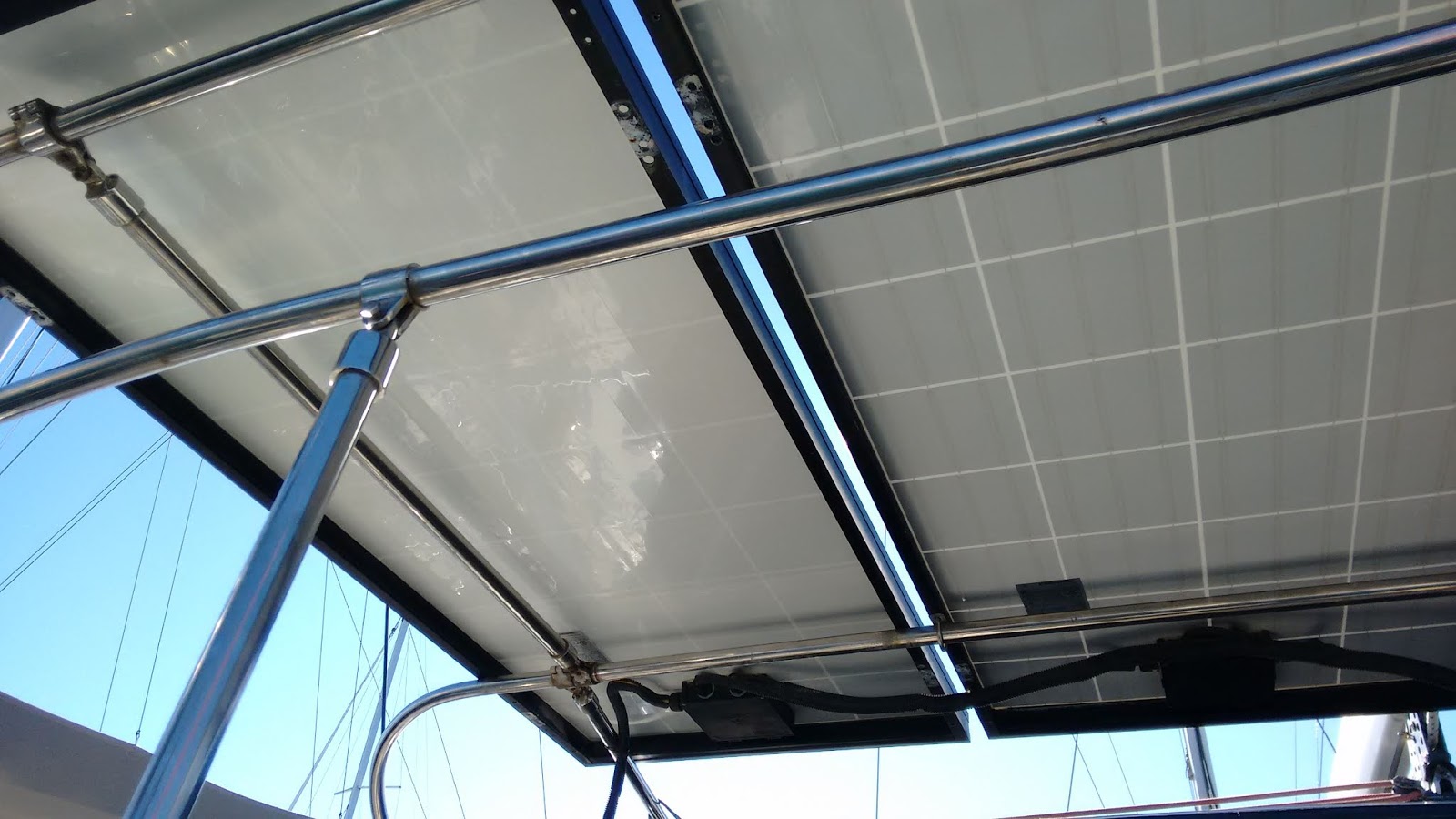
Hydrovane.  Yes, it was time to put the Hydrovane back in business ready for our Atlantic Crossing.  I find it adds an extra rudder giving me some backup if ever we need it too.  It all fitted on well, except I noticed that the vane was connecting with our solar panel framing.  Not good for the vane fabric.  So whilst waiting for the mast repair to be undertaken, I used the time in Portimao Marina to move the solar panels forward a bit.  Easier said than done.  Time well spent.

The Hydrovane (red vane) rubbing on the solar panels.  Lots of kissing in the night!


Moved further apart - all good now

Thursday, March 3, 2016

2015: Going High Tech

iPad and GPS.  I'm not reporting on a breakage but a NEW toy.  For 2014 Christmas my eldest son gave me an iPad, a basic one but a lovely present nonetheless.  I added a waterproof case and a small Garmin GPS – the iPad and the GPS communicate via Blue Tooth.  We still use our laptop on the chart table below as the main nav system.  It’s a great system but, on occasion when you are entering harbour at night time for instance, it would be nice to have something in the cockpit so you don’t have to run up and down stairs frequently.  It’s not a big problem but now, we no longer need to do that .  We have the iPad in the cockpit! 

The iPad has Navionics which we down loaded from the Apple Store (app is free if I remember correctly) and then you download the charts that you want, in this case Europe, for a fee.   The GPS remains out of the way down below telling the iPad where we are via Blue Tooth.

Be careful, I ended up downloading the Caribbean charts too, completely unintentionally.  You can do this if you allow ‘one click’ purchase which I stupidly did thinking it would be more convenient in not having to re-enter information when making a number of purchases.  Well, I thought I was navigating around by pressing this and that but, as it turned out, I purchased a second set of charts.  Trap for (not so) young players.  Anyway, we’ll use the Carib charts eventually when we head back across the ‘pond’.
Anyway, the iPad in the cockpit is just so cool.  We even use it extensively as we just sail along to check on course, speed, etc – saves a trip downstairs.  I can’t speak more highly of this setup.

Another thing to bear in mind.  Unlike the CMap charts, which we have on our downstairs laptop and are loaded/unlocked from CDs/dongle mailed to you by CMap, the Navionics Charts are downloaded over the internet.  This takes some time as you have to download each chart one by one as you work your way along the coast in the area you intend to cruise.  Internet connection for data is essential for the downloading aspect, but otherwise it draws happily on the GPS. 

Fabulous solution - wished we'd done this earlier.  Trying to follow the river channel for nine hours up to Seville (Spain) springs to mind....


View from Castle of San Giovanni, Kotor, Montenegro - WJ3 on anchor

Saturday, August 3, 2013

Bah Humbug!

Pylos, Greece: 2013

(This post has been previously published on our WJ3 site.  As it's been a while since the Cap'n did some serious homework on his "tricking up" of the other woman, this will have to suffice - for a little while longer.  The First Mate is nagging, seriously...)

Sitting on anchor in Pylos, our first Greek port of call after a whirlwind tour through the Med, I’m tempted to hurl a sharp missive to three soothsayers, visitors to the Deltaville Boatyard (Virginia, USA) in, 2010.

Let me set the scene.  There we were at the far end of the boat yard, up on spindly legs getting ready to splash.  Afternoon visitors to the yard were not uncommon and three stopped by for a chat.  Actually, they stopped to highlight Hunter’s foibles, especially as they saw it; "only built to suit coastal conditions," they said.  Like Witches of Endor, they stirred the pot, making even more outrageous dispersions against Hunter, ignoring our rebuttal. 

Finally, they left.  “Rude,” we said in unison.  Had they bothered to listen, WJ3 had already done two laps of the Caribbean Islands, sailed to distant Turks Caicos and managed a tour through remoter Bahamas Islands.  All this before settling on the scenic route to Chesapeake Bay (via the Atlantic ICW). We were on our way to explore Maine.  Hardly dock candy, even then!

So, as we sit on anchor in Greece, about to island hop to Turkey in 2013, we say to them, bah humbug!  WJ3 has 12598 nautical miles tucked under her belt since we started sailing her in 2008.  She has now crossed the Atlantic, comfortably and safely, and this year crossed the Mediterranean.  What a gal!  And not bad for an allegedly “unseaworthy” Hunter!

Now I’m not advocating setting out to sea in a pair of floating shoes (it’s been done before) but boat builders must comply with certain standards.  We’ve also added modifications to make WJ3 more comfortable (eg. a storm trysail) and to improve her safety (eg a sea anchor).  If in doubt, have your craft surveyed and read how others have set up for ocean passages.  We’ve seen expensive Beneteaus kept in marinas for Olympic triangle racing and home-made brutes only a mother could love, floating in far-flung, out of the way places.  

Doubting Thomas’s can check our map tracker here.)
Sharing Keci Buku in Turkey with some real bunnies...

Friday, June 17, 2011

Lessons Learnt from Earl

Hiding from Hurricane Earl: 2010  

Having spent the previous two years cruising a bit quicker than we would have liked because we were always later than planned in getting out of the hurricane zones.  (Ed. Ahem! Largely due to spending a great amount of time undertaking repairs or upgrades.)  First year southwards to Trinidad, then 2009 north to Deltaville.  So we were a bit surprised when, on arriving at South West Harbour, Mt Desert Island, (way up north in MAINE, next to Canada would you believe) we found out a hurricane was on its way.

And due to arrive in the next couple of days. Bloody hell! 

We tried to get into North East Harbour but it was already full of local sailors who were obviously much quicker than us to respond to hurricane warnings.  To be fair though we had been advised that South West Harbour was probably going to be okay but, when a local lobster fisherman and owner of a lobster coop advised that South West Harbour was not the place to be, we followed his advice and hot-footed it to Somes Harbour, at the northern end of Somes Sound.  Fortunately, we were one of the first to arrive and found a good spot to anchor and, over the next day or so, watched as quite a few sailboats joined us or had a look but then departed after probably deciding it was a bit crowded. 

For the next day or so we prepared by getting frequent weather reports, putting out two anchors in tandem (on 200 feet of chain) and digging them in seriously, we took down our sails, and generally stowed things in expectation of a boisterous hurricane.  As it turned out and as the hurricane came closer, while at the same time losing power, we did not need to take down our canvas or fill up the dinghy with water (as originally planned).  On the night of the big blow the wooded hills surrounding Somes Harbour certainly felt Earl’s wrath but, down on the water, our anemometer registered its highest reading of only 34 knots.  A bit of an anti-climax as things turned out but I’m sure it was better than a real hurricane blow.

Fog creeps in ahead of Earl:  Hiding on anchor in Somes Harbor

Saturday, May 21, 2011

Titusville: Land of Lightning Strikes

Titusville, Florida: 2009

Aptly named, we thought afterwards!  WJ3 was struck by lightning while on anchor near the Titusville Marina in July 2009.  In a stunning display of sparks, lightning blew the VHF antenna off the masthead, destroying the windex too and cooking the (old) VHF radio.  Most sensitive electronics no longer functioned properly (they appeared to be okay; lights came on but nobody home!) including some auxiliary autopilot harness components (not the computer, nor the front panel, or the rudder indicator, or the gyro compass – they all checked out okay subsequently).  The fixed GPS lighted up but wouldn’t send information; the handheld GPS showed a position on its dial but would no longer interface with computer.  The water and fuel tank monitoring system also stopped working – I expect it is probably the front panel that failed and I plan to start with that first – an upcoming repair for 2011.


However, the boat’s major metal fittings are grounded and this appears to have saved us from major damage.  I had recently replaced (the day before the strike would you believe) a corroded copper strap joining the base of the mast to a keel bolt (whew).  US-manufactured boats apparently have to be grounded (unlike European-manufactured boats, I’m told) so avoided major structural damages because of this.  Wouldn’t like to repeat the experience however as most technicians simply recommend to replace everything, which of course is very expensive.  It did take quite some time to identify what components worked and what didn’t any more however, so it would probably be a waste of time (and money) to pay for a technician to try and work out where exactly the problem(s) lay rather than just replace stuff, which an owner can fairly easily do.  I plan to replace the sensitive electronic components asap.

You've just got to be there to appreciate these storm fronts
We, thankfully were not hurt despite my standing in the cockpit to watch the storm, as it suddenly changed direction and came directly toward us.  We heard a loud bang and then the First Mate, standing more cautiously on the companionway stairs saw sparks shower behind me into the water.  She said the fishing rods on the stern appeared to light up like Christmas trees. We were the only ones in the anchorage/marina who suffered from a strike that evening.  Our lucky day – yes and no!

Tuesday, May 3, 2011

A Lesson in St Croix

Before we leave the Caribbean, I want to share a valuable lesson or two….
  
Dinghy - Outboard Engine Cut-off.  I jumped into the dinghy from WJ3 with a disconnected painter in my hand without first checking that the engine cut-off clip was in place.  It wasn’t (still back on board) and so we had to paddle back to the boat. It took 20 minutes of hard work to make up 10 metres in a strong-ish current and wind.  We both learnt a lot about dinghy keys and not to cast off prematurely before the dinghy engine starts, especially in a strong current and/or wind and even worse, in isolated areas.
Remote but Beautiful - Buck Island off St Croix
Sailing in Tropical Waters. Reading the channel markers around the treacherous middle reef in Christiansted Harbor can be quite challenging even in the middle of the day on a good tide.  Sadly, it claimed another victim whilst we anchored nearby. You can never be too careful.
Stuck fast in the early morning

Sunday, March 27, 2011

Be Informed from the Getgo!

Whilst in St Martin we started to explore and develop our “local” knowledge of the Caribbean.  We began to appreciate the importance of weather, cruising guides, and security to our voyage planning.  Needless to say, we used the internet where-ever and when-ever we could for information updates and home communications!  Isn’t Skype marvellous?
Trying to get a connection, any connection
Weather:  IF we could pick up an internet connection, our first search was always for weather - hurricane reports as well as local weather.  This is far superior to listening to local anchorage “gossip”. We had a few favourite sites such as Jeff Masters, NOAA and CaribWX.  Later we discovered a few more that were locally specific and quite helpful – windguru and ibiseye.

Cruising Guides: We added to our collection of local cruising guides.  Chris Doyle’s are very good – you would hardly need charts, the descriptions are so clear.  We purchased others to fill in a few blank spots and importantly to get another point of view.  “French for Cruisers” by Cathy Parsons is also money well spent, particularly when you find yourself in a supermarket in French St Martin or trying to negotiate laundry costs in Guadeloupe. 
Guard Iguana at a fuel depot St Martin
Security: We found a monthly newspaper, the Caribbean Compass, gave us an eye on the cruising community.  It made for good reading although we were concerned about news of killings and robberies, especially in Venezuela and even St Vincent.  We chose to just be cautious, lock up and ask locals questions.  We left our dingy strapped firmly to WJ3 & out the water in Dominica.  In St Martin and St Lucia we waited to launch until confirming with marina staff that dingy theft was not an issue.  The crew decorated our outboard with paint and removed evidence of its horsepower.  We also invested in hefty chain & locks.  

The Safety & Security net is also a helpful compilation of reported crime, which makes for interesting reading & useful advice.  Lastly, we came upon regular cruisers’ nets (eg in Trinidad it was VHF Channel 68).  This is a daily update for cruisers on weather, security, general information, equipment swaps/trades and social happenings.
 
St Martin/Sint Maarten was a great place to take stock simply because it caters for all us cruising and/or racing sailors.  There are plenty of well stocked chandleries, all easily accessible and a willingness by staff to assist customers no matter how big (or small) your budget. Then there's the hardware stores but don't get me started....

Saturday, March 26, 2011

2008: St Martin/Sint Maarten in July

Is it Hurricane Season yet?  Whoops!
Marigot Bay, St Martin
Work Completed Underway: Part 2

We stayed almost four weeks in St Martin, firstly anchoring in Marigot Bay, then moving into Simpson Bay Lagoon when a decent blow threatened and then finally had a quiet time in a small boatyard, TOBY (Time Out Boat Yard), filled with character boats, friendly Frenchies and their not-as-friendly dogs.  We took advantage of duty-free prices and haunted Island Waterworld, Kooyman Hardware and Cost-U-Less. 

Generator Overheating.  During our stay in TOBY, the generator overheated, causing us some alarm.  Yes, we were in a marina but unable to use the 240v power, so relied on our trusty generator to keep our batteries full and refrigerators cold.  But weed & other nasties in the lagoon water soon blocked the raw-water intake strainer causing the generator to overheat, sound alarms and stop (thank goodness).   Fortunately no damage was done but it was a close call and not one I’d care to repeat.  We now check the intake strainer much more regularly if the water is in anyway dirty or weedy.
TOBY at the dock to fit our Hydrovane self-steering
High Pressure Water Cleaner.  We purchased a small one of these cheaply at Cost-U-Less.  It uses a fair bit of fresh water but saves an enormous amount of time; cleans deck, cockpit, cushions, etc quickly and easily.  We’ve learnt to clean the barbie at the end of each season too with our water pressure gun, a highly recommended bit of kit. Don’t leave home without one.

BBQ.  We installed a gas barbecue mounted on the pushpit railing –marvellous.  Great in the tropics as it relieves our galley slave from working in a very hot cabin.  Luckily we have two gas bottles mounted in stern lockers so it was a breeze to connect the barbie and still have the main stove connected.  As an added bonus, both use gas conservatively. 
Rainbow over TOBY
GPS and Charts.  We use our laptops with Software on Board (name of software program) with CMaps.  I made sure these can be integrated with an autopilot – just thinking ahead.  I also purchased a Raymarine fixed GPS and integrated this with the chart plotting software.  Again, just great until a subsequent lightning strike in 2009 fixed the GPS and made the wind instrument unserviceable.  A backup Garmin GPS works manually with the chartplotter -  you plot the location reading off the GPS and plotting on the electronic chart.  It can also be connected directly to the laptop and used the same as the fixed GPS ( We couldn’t do that after the lightning strike - to be discussed further in our 2009 stuff).

Log.  We replaced the display (to be able to see details clearly) on our old Autohelm speedo & log. 

Self Steering.  We installed a Hydrovane windvane self-steering while in St Martin – well almost all of one.  The rudder didn’t arrive with the rest of the kit and we subsequently had to chase it around a couple of other countries before finally picking it up at the airport in Guadeloupe (having to pay customs fees, unlike St Martin’s duty free port).  This occurred because the rudder was made at a separate location to the rest of the kit and also the courier service was less than efficient - they did not deliver to the right place and on time.
We had time to relax & celebrate a birthday in Sint Maarten
Radar Reflector.  We installed a radar reflector up in the rigging, just in case it worked…… 

Boat Safety Gear.  Amongst other things I purchased a Plastimo four man liferaft – an offshore type in a valise which was light and compact enough that we could keep in the large cockpit locker.  It only needs to be serviced every three years.  My wife would be able to get it out and deploy it by herself if she had to.  A fibreglass canister one would have been too heavy and, if stored down below, then impossible for her to get upstairs by herself.  I did not want to have a liferaft mounted on deck as there have been many reports of these being washed overboard in storms and/or automatically inflating on deck when whacked with a big wave. 

Wakeboarding on the Lagoon
Dodger Bows.  While we waited at TOBY, I decided to use down-time to have a dodger custom made.  First we zoomed all over the lagoon and Marigot Bay taking photos of suitable designs.  Then we asked MCJ Fabrications (Sandy Ground close to Toby) to make it up.  We wanted a couple of stainless steel bows, one with a handle.  I also wanted it to be as low profile as possible yet still provide access down our "huge" companionway.  To all this, I wanted to be able to see clearly over the top.  The frames were welded up quickly and were well made in top quality stainless.  They fitted perfectly. 

Our dodger canvas work story is not so cheerful.  Let me just say that we were sailing to a schedule and could not wait at the convenience of the canvas shop. We terminated the contract and sailed away.  Before you contract for work, make sure you ask around, not only about quality of work but also timeliness and professional attitude. Be prepared to walk away if you have to.

Additions to the Tool Shed.  My tool boxes keep expanding and filling as I continue to voyage.  I have four boxes now with a number of electrical drills, saber saw, heat gun, and grinder – very handy with the generator – plus a range of hand tools.  I'm not sure if I mentioned that we converted the cabin behind the galley into our tool shed & storage area - best thing we ever did! 

Fishing Lures.  Fishing gear to supplement the lone lure!  We continue to steadily purchase different lures and other fishing kit as we variously deposit them in fishes’ mouths across the sea.  We have caught the odd fish but apparently not nearly as many as all those other cruisers that display exciting photos of landed fish on their respective blog sites.

Wednesday, March 23, 2011

2008: Even More Work in the BVI

Nanny Cay, BVI: Part 3

Minor Repairs.
  Included:

  1. Small Crack in Hull Gelcoat.  Repaired, with epoxy filler, small crack in hull surface gelcoat about a foot above the starboard waterline. 
  2. Timber Repairs.  Numerous bits of furniture, floor lamination, etc were cracked, had come apart, floor laminate lifting, etc and these have generally needed simple ongoing repairs.  The floor panels, teak and holly, are often different shades and, one day, will need replacing.
  3. Stanchion Bases.  A couple of stanchion bases needed to be removed, re-welded and refitted.
  4. Some hairline gelcoat cracks around gunwales, to be repaired.
  5. Navigation lights on mast needed repair ie wiring or globe replacement.
  6. Purchased/fitted safety gear like liferaft, lifejackets, lifesling, flares, etc.
That's right - the refreshments were cold on Virgin Gourda too!
All these repairs, replacements, etc took two months for 2 people plus various contractors.  It was an intense time and we worked all day most days but it resulted in my feeling confident that WJ3 met many of our initial, important priorities.  We could safely sail away to St Martin (& its duty free marine goods) and then on to Trinidad to get out of the hurricane belt (at my insurance company’s insistence). 

It’s important to realise that although you are now in the water and sailing, there are still things that need to be tweaked or added to make life a little less “thrilling” or perhaps just plain common sense.  I’m not advocating for a reckless assault on boys’ toys to pimp up your yacht, just handy gadgets that add to efficiency, safety and comfort.


Crossing the Anegada Passage to St Martin