Showing posts with label work underway. Show all posts

Sunday, February 17, 2019

2017 & 2018: Oh NO! Not the Generator...

Ongoing Saga: #10

Generator Not Starting and Fuel Line Fitting in Canary Islands
.  
In Portugal the diesel generator had been sitting for 9 months and wouldn’t start for reasons I could not understand, so I had a mechanic look at it – several as it turned out.  They replaced the gasket for the cover over the valves, checked valve clearances, adjusted them and eventually they started it and we ran it several times.  Great.  They did not think the injectors needed attention as ‘it runs so well’.  Anyway, off we went and it NEVER started again.  

When in the Canary Islands I discovered, while trying to start the generator, that a bleed valve over the fuel line was not seating properly as the thread would not allow full tightening.  Ah ha!  I thought, this must be the problem – allowing air into the fuel lines – a definite no no.  Fortunately, a visit to one of the marina chandleries proved fruitful and the very helpful gentleman there found a suitable fitting somewhere out the back of the shop which matched my fitting.   It cost next to nothing too and I was so grateful.  Even so, the generator would still not start.

I had two other mechanics check the generator over for me – in Antigua and then Sint Maarten – and they could not start it.  We didn't have time to wait in the Turks Caicos (the weather was a bit iffy) or I would have had a mechanic go over it there too.  The motor turns over fine but just won’t start.  

The consequences of course made themselves clear as we moved along the Atlantic ICW (US coast) where we anchored out rather than hooking up to electrics at marinas.  See comments on batteries.  The plan is to have our very sad generator checked out again when I'm back in the USA.  Another job for next year...


Friday, December 27, 2013

2013: End of Season Comments

Repairs & Maintenance Underway:

Spinnaker Furler  - a further comment… (Spanish Experience).  Well, we didn’t purchase one this year as the particular Profurl model I was after didn’t have any torsion lines available.  They were coming up with an improved torsion line as it turned out and it is now on the market – it looks much better than the original (it appears to have all these little balls on the line which, I assume, makes furling more efficient).  The winds we experienced on our voyage this year didn’t really suit flying spinnakers ie on the nose or, if in the right direction, too strong to fly a spinnaker on a cruising boat.  Something for the future perhaps and it certainly remains on my shopping list.  I will also purchase a removable bowsprit to get the tack of the spinnaker forward of the pulpit.
Some subscribe to really slow boating
Broken Dunny Seat Hinge.  Someone sat down too heavily on our guest dunny (I think it was me) and a hinge broke making it very unsafe at sea (just use your imagination).  New hinges were purchased and one of our guests was asked to take off the old and attach the new (using stainless steel screws this time – why Jabsco use normal steel screws on a marine toilet seat escapes me as they are otherwise an excellent product) while the skipper did other things.  Apparently, it was quite a performance to remove the old screws and hinges but I did realise how “handy” or self-reliant boaties must be in general to keep our boats ticking over and in good working order.  Anyway, the throne is all back together and providing safe seating once again.
Fridge Repairs Underway.  In Greece our fridge and freezer gradually lost most of its refrigerant/gas.  We had to revert to our trusty and reliable (touch wood) Waeco.  Some friendly Canadian neighbours we shared an anchorage with at Kuruca Buku, Turkey had a handheld refrigerant leak detector.  This worked a treat and we quickly identified the leak along the gas line at one of the fittings.  A bit of a tighten with a spanner and no more leak.  When we arrived at Marmaris a fridge technician topped up our gas, checked for any further leaks and we were back in business.  It makes a huge improvement to life on board (for the galley slave particularly).  I will purchase one of these detectors and use it to scan for leaks every week or so – they only cost around $30-50.  If I had done this earlier I would have detected and fixed the leak and regassing is not cheap.  This experience also speaks volumes about cruising camaraderie - somewhat in short supply in a touristy Med.  So, well done & greatly appreciated!
Sunset over Ibiza, Balearics

Monday, December 9, 2013

2011: Finally Crossing the Ditch

Crossing the Atlantic

Repairs Underway: Part 2

Genoa Furling Line.  On our trip across the Atlantic the only gear failure was the genoa furling line started to fall apart and had to be replaced with some spare line.  Not a big problem as it turned out.
Doing a little repair job whilst becalmed
HF Radio.  The HF radio worked as it should and we had good communications with the erstwhile and patient Herb Hilgenburg, the benevolent Canadian who guides so may cruising boats crossing the Atlantic.  We could talk to him quite well, most days atmospheric conditions allowing, all the way to the Azores.  We didn’t use him after that as there was only a thousand miles to go – one week.

Spinnaker Winches.  These have proved to be essential for flying spinnakers and they were also very handy for providing a bit of oomph when we needed to furl headsails in a blow, for example.

Hydrovane wind vane self-steering gear.  We used the Hydrovane almost all the way when crossing the Atlantic.  During a gale we found that sometimes the Hydrovane can be overwhelmed.  I have had to manually steer the boat back on course then reset the Hydrovane to, once again, steer the boat.

Skymate.  We had been really pleased with Skymate’s services (accessing weather forecasts & posting position reports daily on our tracker site) as we sailed through Eastern USA, and its initial assistance as WJ3 moved away from the coast heading for the Azores.  However we eventually began to have connection problems due to, I suspect, fewer available European satellites.  Once we’d made it to the Azores, we ditched it all together and concentrated on finding internet and getting weather reports from Weather Online & Passage Weather. 
 
I have to say that it disappointed when we were crossing the Atlantic even though we had told them when we were crossing.  Where it did shine however was "e-mailing" our GPS reports to our map & tracker - a twice daily task that kept friends & family in touch with our exact position mid-ocean.  (It can be set up to report automatically too, though we didn't bother.)  However, we disconnected it once we got to the Med because there is plenty of local coverage with the internet using a dongle on the computer.  More on that later. 

Of course, we still have all the hardware installed and will probably reactivate the system (there’s a reconnection fee if you disconnect for longish periods) when we depart the Med but only after assurances from SkyMate that we will be better served (for our Atlantic re-crossing) than previously.  I might add, when it all works, it’s a very good system & excellent safety measure.
Getting settled in for night shift

In Horta Marina, Azores taking a well earned rest

Sunday, December 8, 2013

2011: A Late Start

Crossing the Atlantic

Repairs Underway: Part 1

Generally, all repairs & modifications took place before we left Deltaville Boatyard. We were thankful for the assistance provided by the Yard’s skilled technicians and their quality work.  
Our plan was to head north to New York City, or thereabouts, then head east to Europe along the 40th parallel.  Simple, until we reached Baltimore and I carried out a last minute check of some of our gear…. 

Rudder Steering Arm.  On inspection I discovered two cracks in the rudder fitting – steering arm if memory serves me correctly - at the top of the rudder stock and which was attached to the steering via push rods.  Serious stuff and my discovery brought back many memories of the new rudder being fitted in the British Virgin Islands in 2008.  At the time the new rudder’s stock was ever so slightly smaller than the old one and so the old steering arm needed to be fitted accordingly.  At the time the ‘technician’ did this by belting the living daylights out of the (cast) fitting with a hammer until it eventually cracked.  Two weldings later and some shims had it all fitted okey.  Not.  Time had caught up with it and the steering arm had failed along the line of the weld.  So I decided, given our Atlantic crossing plans, it was time to fit a brand new one.
Cracked rudder steering arm
After some discussion in Baltimore & Annapolis at various yards, we hoofed it back to Deltaville, reasoning that they understood us and our boat.  Kindly they responded to our short time line (we really needed to get going on our crossing) where they measured the rudder stock precisely and a new fitting was ordered.  It’s interesting to note that Edson, the supplier, needed a reading that was accurate to within three thousandths of an inch.  On being given these dimensions they then bore the hole in the fitting.  It fitted perfectly and is still doing sterling service.
 
Hauling out at short notice
More Steering Breakages.  At this late stage we decided to sail south a relatively short distance to Norfolk, at the southern end of the Chesapeake Bay, and then head off for Europe from there.  The first night out, as you do, we had a fine gale which was quite unexpected.  We also lost autopilot steering when the cog, on the other end of the shaft that the steering wheel is fitted to, sheared so that the chain to the autopilot motor was completely disconnected. 

Unhappily, but not wanting to steer all the way across the Atlantic, we turned back to Norfolk, ordered a new replacement shaft, had the broken one repaired too, fitted the new shaft and autopilot chain, then headed north to New York City (again). 

As we had no further problems we then headed east for Europe via the Azores. As you do!
Some of the crew added their own modifications
which came with a drinks service too!

Friday, June 17, 2011

Lessons Learnt from Earl

Hiding from Hurricane Earl: 2010  

Having spent the previous two years cruising a bit quicker than we would have liked because we were always later than planned in getting out of the hurricane zones.  (Ed. Ahem! Largely due to spending a great amount of time undertaking repairs or upgrades.)  First year southwards to Trinidad, then 2009 north to Deltaville.  So we were a bit surprised when, on arriving at South West Harbour, Mt Desert Island, (way up north in MAINE, next to Canada would you believe) we found out a hurricane was on its way.

And due to arrive in the next couple of days. Bloody hell! 

We tried to get into North East Harbour but it was already full of local sailors who were obviously much quicker than us to respond to hurricane warnings.  To be fair though we had been advised that South West Harbour was probably going to be okay but, when a local lobster fisherman and owner of a lobster coop advised that South West Harbour was not the place to be, we followed his advice and hot-footed it to Somes Harbour, at the northern end of Somes Sound.  Fortunately, we were one of the first to arrive and found a good spot to anchor and, over the next day or so, watched as quite a few sailboats joined us or had a look but then departed after probably deciding it was a bit crowded. 

For the next day or so we prepared by getting frequent weather reports, putting out two anchors in tandem (on 200 feet of chain) and digging them in seriously, we took down our sails, and generally stowed things in expectation of a boisterous hurricane.  As it turned out and as the hurricane came closer, while at the same time losing power, we did not need to take down our canvas or fill up the dinghy with water (as originally planned).  On the night of the big blow the wooded hills surrounding Somes Harbour certainly felt Earl’s wrath but, down on the water, our anemometer registered its highest reading of only 34 knots.  A bit of an anti-climax as things turned out but I’m sure it was better than a real hurricane blow.

Fog creeps in ahead of Earl:  Hiding on anchor in Somes Harbor

Thursday, June 16, 2011

2010: Annapolis & The Solomons

Work Completed Underway: Part 2

Anchor Riding Sail.
  We made it to the annual Annapolis boat show – the biggest in the world we’re told.  We visited for one whole day and still missed some parts of it. One of our purchases was an anchor riding sail that impressed us as a logical solution to WJ3’s tendency to dance around a bit while on anchor in a fresh breeze.  You hoist this three dimensional triangular sail with a topping lift and attach it to the end of your boom and with  guys out to the sides – it steadies the boat holding it into the breeze and so, much less sailing around on anchor or a mooring. 
Hi Vis with the new Anchor Riding Sail (JGP Photo)
Fuel Again.  Having said we had no further fuel problems really meant that I knew how to deal with it when it raised its ugly head again off Oxford.  We were full of the joys of the world having had a good season up north, made it safely back to the Chesapeake, and experienced the delights of the Annapolis Boat Show, so the last thing we expected was to have fuel problems again.  In the little village of Oxford, we dragged on anchor during the night (in fairly stiff winds and poor holding) and decided to leave in the dark.  In the worst possible place at the worst possible time the engine stopped.  It could only have been fuel.  I hadn’t refuelled for some time and dregs were an issue now.  We turned back (under sail) and anchored in the river until daylight and a fuel dock opened.  Exciting stuff!

Whisker Pole.  That same day, once we beat our way out of the choppy Choptank, we set a fair pace down to the Solomons with the wind behind us so I poled out sail.  Much to my annoyance the cheap, nasty (metal look-alike) fittings on the whisker pole almost disintegrated.  I eventually replaced them with much more substantial Ronstan fittings purchased in Australia.
WJ3 at anchor in Back Creek, Solomons Island
Welding in the Solomons.  On top of the steering pedestal in the cockpit there is a semi-circular stainless steel grab rail; it’s always been there (most sailboats with wheel steering have them) and you tend to take it for granted – until it breaks and you can’t use it, which is what happened to us.  The weld at the base of one of the legs had failed so it was not safe to use.  Of course, we arrived back in the Solomons on a weekend so I wasn’t expecting to have a lot of success in getting it fixed.

However, I visited the local West Marine and made some enquiries.  There was a guy standing at the counter who just happened to know of a welder nearby, had used him on his own boat a lot, and, best of all, my new-found best friend offered to drive me there, as the welder lived a few miles away.  To cut a long story short, the next day I had a vastly stronger grab rail reattached to the steering pedestal – it cost $200 but the fittings that had been welded into both bases will outlast all my other stainless.  The welder happened to work from home in a big barn-like shed that was so well equipped that my eyes watered with envy.  He also happened to be a great bloke, believed that quality was much more important than cheap quantity, and very obliging by doing it quickly. 

My new best friend turned out to be the same guy, with his wife, that the First Mate and I had shared a friendly conversation with at the local Holiday Inn bar where we stopped for refreshments while on our way north a few months earlier.  Our conversation had to start when we noticed that his wife had ordered a bucket of cocktails of various flavours and alcohol – it was huge.  Anyway, she enjoyed it, we enjoyed the ensuing discussion about it and, lo and behold, the husband just happened to be at the West Marine counter when I showed up with my busted grab rail.  Another tale of a small world and meeting some of the nicest people while cruising.

Wednesday, June 15, 2011

2010: Great Kills Harbor

Work Completed Underway: Part 1

Our trip to Maine, although delayed by my work schedule, went ahead as planned – more or less.  Well, less actually because we didn’t make Nova Scotia.  As Hurricane Earl (Sep 10) followed us up the coast and sideswiped Nova Scotia, we were pleased to have missed the worst of it in our hideout in Somes Harbor, Mt Desert Island.


Having spent some 10 weeks doing repairs and upgrades doesn’t necessarily mean that we escaped the joys of repairs underway.  Gunk in the fuel tank was our most dramatic problem, given that we were without a functioning engine and had to anchor under “sail power” twice during the season; and always when conditions were at their worst….
R2D2 our new oil filter that seems to have worked miracles...
Diesel Fuel System.  I always put fuel additive into the fuel tank whenever I refill but it doesn’t seem to have fixed a perennial problem of gunk in the fuel, as found in the primary filter from time to time.  As each season goes by, and the fuel is turned over as we motor a lot (on Chesapeake Bay, ICW, etc), it generally cleans up without anything more than routine checks of the primary filter to clear any build up of gunk, and occasional filter changes.  This year it let us down offshore near Atlantic City, and after we’d motored quite a few miles (up the Chesapeake Bay, thru the Chesapeake and Delaware Canal, then down Delaware Bay), we had to sail along the coast and then into Sandy Hook to anchor – a sobering and thrilling event, especially for the First Mate who had to helm while I worked the sails. 

So I decided to upgrade the primary fuel filter for a bigger and better one, thinking that it would solve our woes – a Racor M500.  It didn’t come with the right fuel line fittings for WJ3 (3/8’’ elbows) so the guys that ably and charitably assisted me (see the story on our blog) came up with a combination of fittings to get by with – hence R2D2 was born.  I put it all together and fired up the Yanmar, only to have it cough and die a few minutes later.  Oh dear, only one course left to me, as advised to me as a sort of last thought as I left the dock with R2D2 in hand, and that was, if I had further problems with fuel, undo the fuel fitting on top of the tank and check for any blockage.  With a desperate  and heavy pit in my stomach I followed the instructions – a pretty easy task as it turned out, just undo a few screws, take off the hose, and, voila, a very blocked ball valve.  Aaaahhhhh, so that’s what’s been causing all the problems.  I shoved some wire thru it, blew into it and got out all the gunk.  No problems again for the rest of the season.  What a !@#$% relief!!

Time to relax & think of nice things_ Great Kills Harbour

Saturday, June 4, 2011

Jacksonville: Down on City Dock

City Dock, on St Johns River: 2009

To avoid damage from any further lightning strikes we usefully employed
jumper leads (connected to the stays and dropped in the water) at any
sign of bad weather.  An Old Sailor's Trick or Old Wives' Tale...

While we were docked in Jacksonville at the free town dock, we sought advice about repairing lightning damaged electronics.  This was an expensive lesson for no new information, and in the end, I removed the black boxes and took them home to Australia where I knew that I had time for repairs to be undertaken (and not be in a rush to escape hurricane season in Florida).  I could also be more certain of advice and that items could be repaired in appropriate manufacturers’ service centres.

In the USA the fuel injector pump started to leak around the edges/gasket, so I removed it myself and had it professionally repaired/serviced at a diesel engine shop in Jacksonville.  I had to refit it myself due to time restraints – no leaks since.   The shop was some distance out of Jacksonville CBD, so the bike got a good work-out that day – so did I in the heat!  When putting the pump back in the generator I had an awful experience when a locking pin fell inside the generator.  I eventually recovered it after about an hour or more ‘fishing’ around.  Needed a beer or two that night to replace lost body fluids!  It sure was hot in Jacksonville.
Loads of traffic on the river to Jacksonville

Sunday, May 29, 2011

Daytona Dreamin'

There's a beach in there. Well, somewhere!
Halifax Harbour Marina, Daytona: 2009

We limped on to Daytona, staying at Halifax Harbor Marina for a week licking our wounds and hoping that repairs could be made - quickly.  Although Jacksonville was later suggested as a better option for Simrad & other electronic gear repairs, we took the opportunity to have the regulator and inverter/charger replaced by Mike, a friendly and helpful local.  Our old one had ceased to work properly ie batteries were not being recharged efficiently when the main engine was running. I cannot say whether this was caused by the lightning strike but it seems, in hindsight, rather coincidental, although they didn’t fail immediately as a result of the strike.

Calm after the Storm
We took the chance to lookover Daytona's famous beaches and fast cars.  We even found a few bargain boat bits shops - a chance to stock up on well, more stock, for the store room.  GS tells me WJ3 is seriously listing to the left.
Hot Wheels in Daytona

Saturday, April 23, 2011

2009: Trinidad to the Chesapeake

We said goodbye to friends in Trinidad


Work Completed Underway: 2009

We managed to escape Trinidad ….eventually!  The budget was somewhat depleted but we now had an autopilot - a tolerant and hardworking addition to our crew.  Our lives became a lot easier - although the self-steering, Burt was a bit miffed at being packed away!  More repairs underway took centre stage – always at the wrong time. 

Galley Bench.  The galley centreline bench was not attached at all to the stringer at its base on the floor, as it should have been and as shown in the Owner’s Manual.  I had to carry out repairs after the bench started shifting while we were sailing along in a seaway between Dominica and Guadeloupe; it was no fun for either skipper or crew!  Sadly, an example of lack of supervision in the manufacturing process.

Found an aquarium all to ourselves
in the Bahamas
Hose Clips.  I have also replaced quite a lot of old hose clips on fuel lines as we travel on. Loose clips allow air to be sucked in which occasionally cuts out the engine – and that never happens at convenient places or times.  We even found clips in out of the way places like Black Point (Exumas) so I now have a box full of various sizes and regularly check hose clips whenever accessing the boat’s plumbing.  Even though they are stainless steel an extraordinary number of them corrode and you only have to try and tighten them with a screwdriver/wrench and it soon becomes apparent when they no longer hold i.e. they easily rotate without tightening.  I throw these old ones away.

Engine Fan Belt.  The fan belt broke just as we were coming into a tricky anchorage at Normans Cay, the Bahamas!  The engine’s horn sounded and its dial showed a rather high temperature, but when I throttled down, I was able to lower the water temperature (I knew because the horn stopped blaring) and made for the anchorage at almost idle speed.  Not good when dodging coral bommies in an unfamiliar harbour.  After anchoring, I replaced the fan belt with a spare (fortunately) carried on board.  A very forgiving engine!!
Do you think they sell fan belts & hose clips too?

Saturday, March 26, 2011

2008: St Martin/Sint Maarten in July

Is it Hurricane Season yet?  Whoops!
Marigot Bay, St Martin
Work Completed Underway: Part 2

We stayed almost four weeks in St Martin, firstly anchoring in Marigot Bay, then moving into Simpson Bay Lagoon when a decent blow threatened and then finally had a quiet time in a small boatyard, TOBY (Time Out Boat Yard), filled with character boats, friendly Frenchies and their not-as-friendly dogs.  We took advantage of duty-free prices and haunted Island Waterworld, Kooyman Hardware and Cost-U-Less. 

Generator Overheating.  During our stay in TOBY, the generator overheated, causing us some alarm.  Yes, we were in a marina but unable to use the 240v power, so relied on our trusty generator to keep our batteries full and refrigerators cold.  But weed & other nasties in the lagoon water soon blocked the raw-water intake strainer causing the generator to overheat, sound alarms and stop (thank goodness).   Fortunately no damage was done but it was a close call and not one I’d care to repeat.  We now check the intake strainer much more regularly if the water is in anyway dirty or weedy.
TOBY at the dock to fit our Hydrovane self-steering
High Pressure Water Cleaner.  We purchased a small one of these cheaply at Cost-U-Less.  It uses a fair bit of fresh water but saves an enormous amount of time; cleans deck, cockpit, cushions, etc quickly and easily.  We’ve learnt to clean the barbie at the end of each season too with our water pressure gun, a highly recommended bit of kit. Don’t leave home without one.

BBQ.  We installed a gas barbecue mounted on the pushpit railing –marvellous.  Great in the tropics as it relieves our galley slave from working in a very hot cabin.  Luckily we have two gas bottles mounted in stern lockers so it was a breeze to connect the barbie and still have the main stove connected.  As an added bonus, both use gas conservatively. 
Rainbow over TOBY
GPS and Charts.  We use our laptops with Software on Board (name of software program) with CMaps.  I made sure these can be integrated with an autopilot – just thinking ahead.  I also purchased a Raymarine fixed GPS and integrated this with the chart plotting software.  Again, just great until a subsequent lightning strike in 2009 fixed the GPS and made the wind instrument unserviceable.  A backup Garmin GPS works manually with the chartplotter -  you plot the location reading off the GPS and plotting on the electronic chart.  It can also be connected directly to the laptop and used the same as the fixed GPS ( We couldn’t do that after the lightning strike - to be discussed further in our 2009 stuff).

Log.  We replaced the display (to be able to see details clearly) on our old Autohelm speedo & log. 

Self Steering.  We installed a Hydrovane windvane self-steering while in St Martin – well almost all of one.  The rudder didn’t arrive with the rest of the kit and we subsequently had to chase it around a couple of other countries before finally picking it up at the airport in Guadeloupe (having to pay customs fees, unlike St Martin’s duty free port).  This occurred because the rudder was made at a separate location to the rest of the kit and also the courier service was less than efficient - they did not deliver to the right place and on time.
We had time to relax & celebrate a birthday in Sint Maarten
Radar Reflector.  We installed a radar reflector up in the rigging, just in case it worked…… 

Boat Safety Gear.  Amongst other things I purchased a Plastimo four man liferaft – an offshore type in a valise which was light and compact enough that we could keep in the large cockpit locker.  It only needs to be serviced every three years.  My wife would be able to get it out and deploy it by herself if she had to.  A fibreglass canister one would have been too heavy and, if stored down below, then impossible for her to get upstairs by herself.  I did not want to have a liferaft mounted on deck as there have been many reports of these being washed overboard in storms and/or automatically inflating on deck when whacked with a big wave. 

Wakeboarding on the Lagoon
Dodger Bows.  While we waited at TOBY, I decided to use down-time to have a dodger custom made.  First we zoomed all over the lagoon and Marigot Bay taking photos of suitable designs.  Then we asked MCJ Fabrications (Sandy Ground close to Toby) to make it up.  We wanted a couple of stainless steel bows, one with a handle.  I also wanted it to be as low profile as possible yet still provide access down our "huge" companionway.  To all this, I wanted to be able to see clearly over the top.  The frames were welded up quickly and were well made in top quality stainless.  They fitted perfectly. 

Our dodger canvas work story is not so cheerful.  Let me just say that we were sailing to a schedule and could not wait at the convenience of the canvas shop. We terminated the contract and sailed away.  Before you contract for work, make sure you ask around, not only about quality of work but also timeliness and professional attitude. Be prepared to walk away if you have to.

Additions to the Tool Shed.  My tool boxes keep expanding and filling as I continue to voyage.  I have four boxes now with a number of electrical drills, saber saw, heat gun, and grinder – very handy with the generator – plus a range of hand tools.  I'm not sure if I mentioned that we converted the cabin behind the galley into our tool shed & storage area - best thing we ever did! 

Fishing Lures.  Fishing gear to supplement the lone lure!  We continue to steadily purchase different lures and other fishing kit as we variously deposit them in fishes’ mouths across the sea.  We have caught the odd fish but apparently not nearly as many as all those other cruisers that display exciting photos of landed fish on their respective blog sites.

Friday, March 25, 2011

2008: British Virgins to Trinidad


Potters Bar on Anegada, BVI.  So!  Where are the lobsters? 
Work Completed Underway: Part 1

You would think that having worked solidly for two months in the BVI, there would be little left to do.  There's nothing like experience, so being on the water with sails hoisted or engine purring away highlighted one or two more little gaps in my workplan.  Many a truth is said in jest and Break Out Another Thousand is not too far from reality. 

The need to move on from the BVI was dictated by the weather….and insurance requirements, but WJ3 was now starting to take shape.  We did a little break-out cruise or two around the BVI, enjoying the clear waters and plentiful bars.  The BVI it seems is out to be hospitable to the large chartering fleets that nose about in every nook and cranny.  Despite large numbers of sail and motorboats on the water, picturesque bays remained accessible and there always seemed to be a spare mooring or more available if needed, and of course competent marinas.  However, I couldn’t in all honesty say that the government officials we reported to as we cleared in & out, were as friendly in dispensing their duty as many of the tradesmen and restaurant/bar staff we had come to know in our time there.
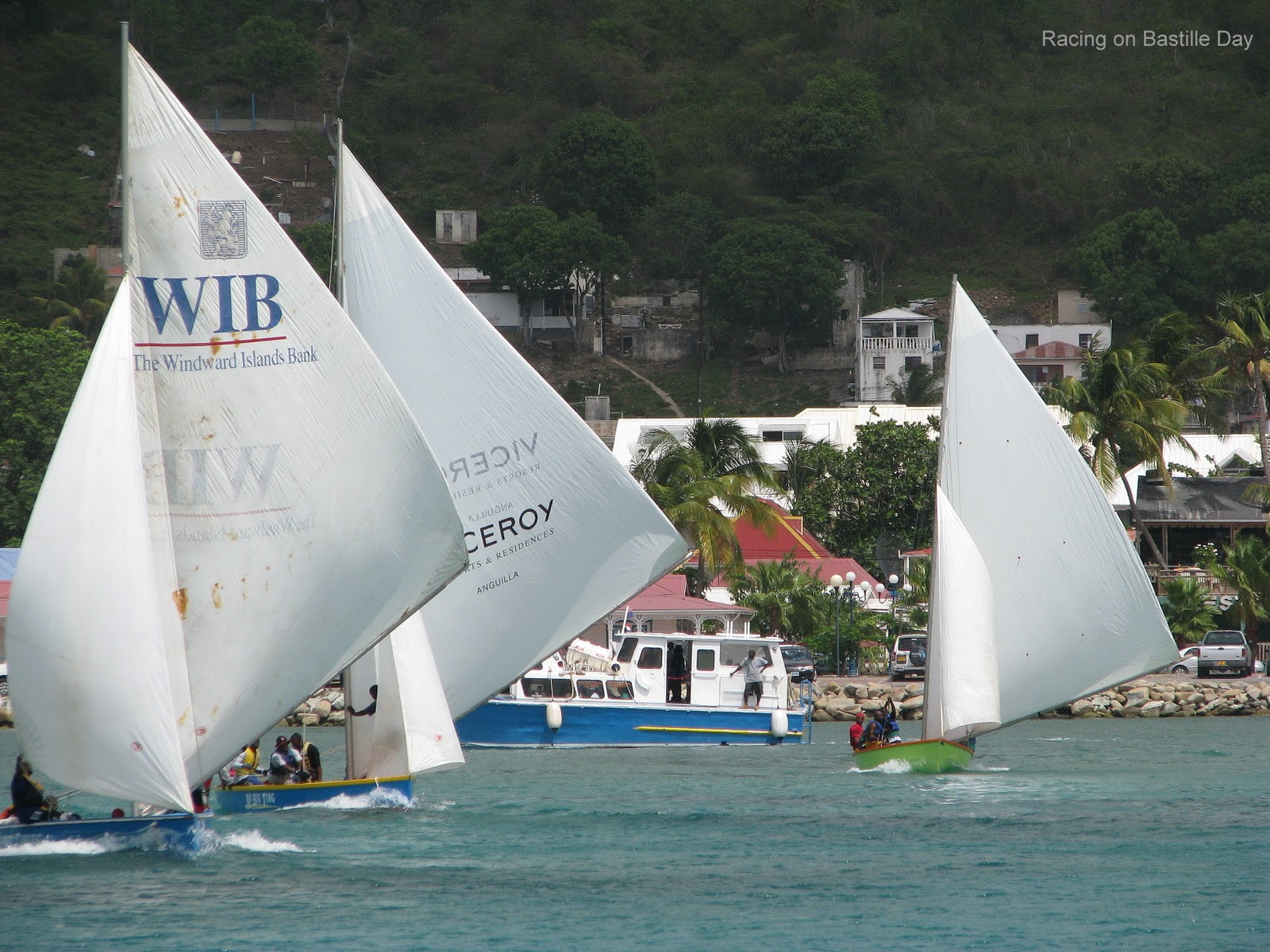
Local Racing Boats in Marigot Bay, St Martin 
Our first overnight sail involved getting from Anegada (BVI) to Marigot Bay, French St Martin across the much discussed (for all the wrong reasons) Anegada Passage.  A strong current pushed us slightly off course which added a few extra hours to our trip but that’s not too bad considering we didn’t have a GPS linked into our CMap charts.  Hourly readings on a hand-held GPS are for the birds!  Guess what one of the first things we did when we got to St Martin?  Yep, buy a BBQ!